On this page
› Running a Café in 2026 Is Harder Than the Romanticized Version
The coffee shop is one of the most enduringly appealing business concepts in American entrepreneurship — a community space, a craft product, a local institution. The U.S. café industry generates around $70 billion in annual sales, global revenue is on track to hit $500 billion by 2030, and millennials visit cafés frequently. On the surface, it looks like a business category where demand is never the problem.
The cost pressures that intensified during 2025 continue to affect cafés in 2026, and this was not due to a single reason but due to several factors coming together. Arabica coffee futures reached a historic high of $4.41 per pound in February 2025, a 79% increase compared to the previous year. The major reasons behind this price increase were severe droughts in Brazil and supply disruptions in Vietnam. The situation was further complicated by the imposition of a 50% U.S. tariff on Brazilian coffee beans, which caused retail coffee prices in the U.S. to increase by 41% year-over-year. For those for whom the cost of coffee was already one of the most volatile costs in the profit and loss statement, this was not a temporary price increase that would automatically normalize after some time. It was a structural shift in the economics of the business.
Simultaneously, labor costs — already the single largest expense category at 32 to 35% of operating costs — continued climbing as minimum wage increases took effect across 19 U.S. states. Staff turnover in cafés averages 65% annually, meaning the average café is replacing nearly two-thirds of its workforce every year. This situation is made even more difficult by the problem of peak hours. 70% of daily sales occur between 7 and 10. These are the three hours where accurately planned staffing has a direct impact on revenue.
The final result of all these factors is that the average independent cafe's net profit margin in 2025 is approximately 10% to 14%. Well-managed cafes can achieve margins of 15% to 25%, while new cafes often hover around 5% to 10% in their first year. These margins leave little room for operational inefficiency, as even small inefficiencies can significantly impact profits.
“Most coffee shop owners can tell you their revenue. Fewer can tell you their net margin. Almost none can tell you the exact gross margin on each menu item — and that gap in knowledge is precisely why the median independent café owner earns less than a shift supervisor at a corporate chain.”
Most coffee shop owners can tell you their revenue. Fewer can tell you their net margin. Almost none can tell you the exact gross margin on each menu item — and that gap in knowledge is precisely why the median independent café owner earns less than a shift supervisor at a corporate chain.
› 1. Point of Sale System — The Operational Core
POS Software is one of a café's most important technology decisions because nearly all of a café's operations run through it. Orders, payments, inventory adjustments, tip distribution, end-of-day reporting, and the data that guides every operational decision from staffing levels to menu changes all rely on the POS system. A POS that is slow during the morning rush is not just an inconvenience — it is a direct revenue constraint, because a barista waiting for a screen to respond is a barista who is not making drinks.
Coffee shops' POS requirements are quite different from normal restaurant systems. Drink modifier handling — the ability to ring up a 'large oat milk cortado with an extra shot and vanilla syrup' in under five seconds — is not a nice-to-have. It is the operational baseline. Similarly, offline mode is also very important. If the internet goes down for 20 minutes during peak hours and the cafe is unable to process payments, it suffers a direct financial loss because sales stop.
There's a clear trend emerging in the market for independent cafes in 2025. An analysis of 58,548 independent coffee shops found that the biggest problem is the disconnect between in-store POS and online ordering systems. Many independent cafes are using separate systems for both, which creates complications in operations and data management. This has made Toast the most popular choice for most cafes, while Square is more commonly used for new or smaller operations.
| Tool | Best For | Price(Approx.) | What Sets It Apart |
| Toast POS | Most independent cafés | Free – $165/mo + hardware | Coffee-specific modifier flow; offline mode; KDS integration; strong ecosystem |
| Square for Restaurants | New or small single-location cafés | Free – $60/mo | Zero monthly fee to start; fast setup; no hardware commitment required |
| Lightspeed Restaurant | Inventory-focused café operators | ~$189/mo | Recipe costing built in. ingredient-level tracking; multi-location reporting |
| Clover POS | Cafés in the Bank of America ecosystem | ~$14–95/mo + hardware | App marketplace; strong payment processing; multiple hardware options |
| Revel Systems | iPad-based café chains | ~$99/mo + hardware | iPad-native; strong offline mode; Multi-location management is built in |
| Shopify POS | Cafés with significant retail/merch | ~$89/mo | Online + in-person unified; best for cafés selling beans or subscriptions |
“Critical feature to verify: Test the modifier flow for your most complex drink in front of the vendor. Time it. If it takes more than 8 seconds to ring up a fully modified specialty drink, that friction multiplies across hundreds of transactions during your morning rush every day.”
› 2. Online Ordering and Delivery Integration
Online ordering is still a revenue channel for independent cafes that has a significant impact, but not many cafes are taking full advantage of it. The most common setup — Shopify or WooCommerce online with a separate POS in-store — works but introduces unnecessary operational drag.
There are two distinct channels with different economics. First-party online ordering carries no commission and keeps customer data in your hands. Third-party platforms charge 15 to 30% commission per order but provide discovery to new customers. The strategic answer is to build a first-party ordering capability as the primary channel, use third-party platforms for incremental volume, and manage the economics of each carefully.
You May Also Like: Online Ordering Software
| Tool | Best For | Price(Approx.) | What Sets It Apart |
| Toast Online Ordering | Toast POS users | Free – $75/mo | Fully integrated with Toast POS; no commission; direct to kitchen display |
| Square Online | Square POS users | Free – $72/mo | Built on Square; real-time sync; mobile ordering and pickup scheduling |
| Olo | Multi-location café groups | Contact for pricing | Enterprise-grade online ordering; deep POS integrations; aggregation layer |
| DoorDash | Delivery and discovery channel | 15–30% commission/order | Largest delivery marketplace; DashPass subscriber access |
| Uber Eats | Urban and suburban delivery | 15–30% commission/order | Broad customer base; Uber One loyalty crossover |
| joe Coffee | Independent café mobile ordering | Small fee per order | Built specifically for independent cafés; loyalty integration; no app download |
› 3. Loyalty Programs and Customer Retention
Coffee is one of the highest-frequency consumer purchases in the U.S. — millennials alone average 5.2 café visits per week. That frequency creates a loyalty dynamic unlike almost any other retail category. A customer who visits twelve times per month instead of eight is worth 50% more in annual revenue, and the marginal cost of that additional visit is essentially zero.
Seventy-three percent of customers now expect personalized digital rewards from their loyalty programs — a generic 'earn one point per dollar' program does not meet that expectation for a customer who has options. The distinction that matters most is between a stamp card and a data-driven program. A paper stamp card tells you a customer has visited ten times. A digital loyalty program tells you that this customer visits every Tuesday and Thursday morning, orders a flat white with oat milk, and has not been in for two weeks.
| Tool | Best For | Price(Approx.) | What Sets It Apart |
| Toast Loyalty | Toast POS users | ~$25/mo | Fully integrated with POS; points auto-applied at checkout; campaign tools |
| Square Loyalty | Square POS users | ~$45/mo | Native Square integration; automated rewards; customer visit tracking |
| Stamp Me | Simple digital punch card replacement | ~$30/mo | Easy to deploy; mobile app for customers; works with any POS |
| Paytronix | Established multi-location cafés | Contact for pricing | Advanced segmentation; AI-driven offers; gift card + loyalty combined |
| Thanx | Experience-led café operators | Contact for pricing | Credit card-linked loyalty — no app required; behavioral spend analytics |
› 4. Inventory and Ingredient Management — Where Margin Is Won or Lost Daily
Food and beverage cost — COGS — should sit at 28 to 35% of revenue in a well-managed café. The gross margin on drip coffee ranges from around 85% to 90%. Espresso drinks land at 65 to 75%. Food items range from 40 to 65%. The shops that clear 15%+ net margin are not charging more — they are controlling labor, minimizing waste, and engineering their menus to push high-margin items.
With Arabica prices up 79% year-over-year and remaining structurally elevated, the urgency of knowing your cost per drink — by-drink, precisely, has never been higher. A café that repriced its espresso drinks in January 2024 and has not revisited that calculation since is almost certainly selling some drinks at a margin that has been cut in half by the commodity market shift.
| Tool | Best For | Price(Approx.) | What Sets It Apart |
| MarketMan | Recipe costing + ordering automation | ~$239/mo | Vendor management; auto-ordering; waste tracking; cost-per-dish analytics |
| BlueCart | Wholesale ordering automation | ~$100/mo | Digital ordering to distributors; invoice management, and order history |
| Craftybase | Cafés with in-house baking or roasting | ~$49/mo | Production tracking; ingredient-level COGS; batch cost calculation |
| Lightspeed Inventory | Lightspeed POS users | Included in Lightspeed | Recipe costing is built into the POS. real-time depletion on every sale |
| xtraCHEF | Invoice processing + COGS tracking | Contact for pricing | Invoice scanning; price change alerts; COGS dashboard integrated with POS |
“Margin engineering: Build a cost card for every item on your menu at current market prices. Run it quarterly, not annually. With bean prices as volatile as they were in 2025, a cost card that is eight months old is lying to you about which items are profitable.”
You May Also Like: Top-Rated Inventory Management Software
› 5. Staff Scheduling and Labor Management
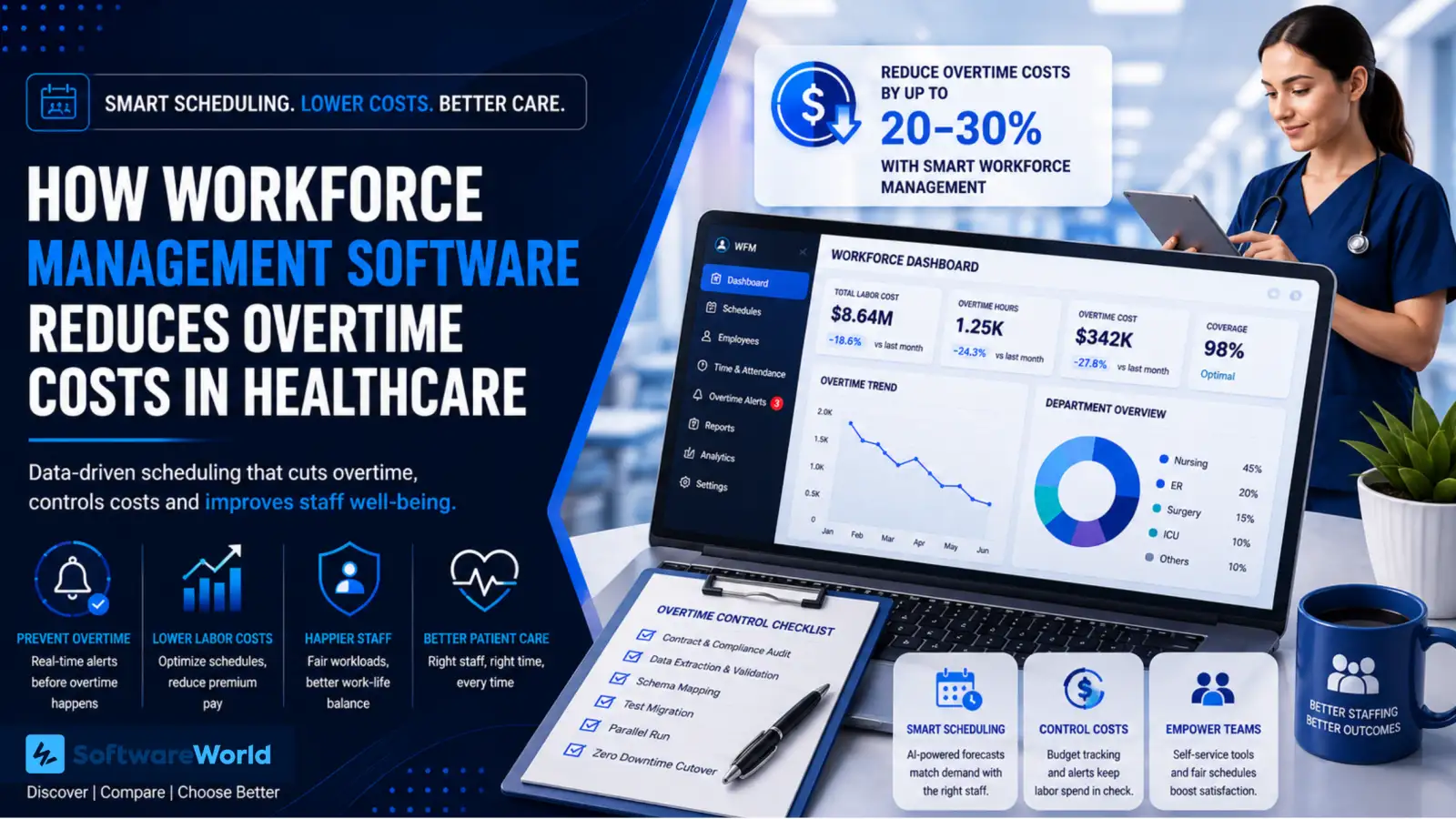
Labor is the highest controllable cost in a café. At 32 to 35% of revenue, it is also the cost with the most levers. The specific challenge is that labor demand is intensely time-concentrated: 70% of daily sales happen between 7 and 10 AM. A café that is appropriately staffed for that three-hour window and overstaffed for the remaining hours is still losing margin on the slow periods.
Staff turnover at 65% annually means the average café with 10 employees is hiring and training 6 to 7 new people per year. Scheduling software that reduces the friction of shift management, enables staff to request shifts through a mobile app, and sends automated reminders reduces the administrative load in a category where owners are often also the morning shift barista.
| Tool | Best For | Price(Approx.) | What Sets It Apart |
| 7shifts | Restaurants and cafés; scheduling focus | Free – $29.99/mo | Labor cost forecasting vs. sales; tip pool management; schedule by role |
| Homebase | Small cafés; hourly scheduling | Free – $99/mo | Free tier covers basics. time clock, team messaging, and payroll export |
| Deputy | Scheduling + compliance for growing cafés | ~$3.50/user/mo | Demand-based scheduling; labor law compliance alerts; multi-location |
| When I Work | Simple mobile-first scheduling | ~$2.50/user/mo | Mobile app for staff self-service; open shift management; clock-in |
| Toast Scheduling | Toast POS users | Add-on to Toast | Scheduling linked to sales data; labor cost visible against daily revenue |
› 6. Email Marketing, SMS, and Customer Communication
Independent cafés have a customer communication advantage that chains cannot replicate: the personal relationship. A regular customer who gets an email from their neighborhood café saying, 'our Ethiopian single-origin from Yirgacheffe just arrived, and we thought of you,' has a different experience than a mass chain promotion. The challenge is building the infrastructure to send that message to the right person.
Email marketing Software for cafés works best when tied to specific occasions rather than a rigid weekly cadence. Seasonal menu launches, new bean arrivals, limited-time drinks, and loyalty milestone rewards all generate engagement. SMS has a meaningfully higher open rate than email — typically 90%+ within three minutes of delivery — and works well for time-sensitive promotions.
| Tool | Best For | Price(Approx.) | What Sets It Apart |
| Mailchimp | Email marketing for most cafés | Free – $20/mo | Easy automation; audience segmentation; Good analytics for small lists |
| Klaviyo | Data-driven email + SMS | ~$45/mo | Behavior-based triggers; POS integration via Zapier; strong segmentation |
| Podium | SMS marketing + review management | ~$300/mo | Two-way SMS; review request automation; Google review management |
| Attentive | SMS-first customer communication | Contact for pricing | Personalized SMS at scale; compliance-built; high deliverability |
| Toast Marketing | Toast POS users | Add-on to Toast | POS data-triggered campaigns; segmentation by order history |
› 7. Website and Local Search Presence
A café's website has to do more than look good. It has to convert. The visitor who found you through a Google search for 'specialty coffee near me' needs to see your hours, your menu, a way to order, and enough of your personality to decide whether this is the kind of place they want to spend time. That entire journey should be completed in under 30 seconds.
Google Business Profile is the single most important local search asset a café has, and it is free. A fully completed, actively managed profile — hours correct, seasonal menus uploaded as photos, every review responded to, weekly Google Posts published — is the difference between appearing in the Local Pack for 'coffee shop open now near me' and not.
| Tool | Best For | Price(Approx.) | What Sets It Apart |
| Squarespace | Clean, manageable café website | $23–65/mo | Best design templates in its tier. menu blocks; online ordering embeds |
| Wix | DIY with more flexibility | $17–35/mo | App market; booking integration; good for cafés with event programming |
| WordPress + WP Engine | SEO-focused custom sites | $30–100/mo | Full SEO control; blog for coffee content marketing; developer required |
| BentoBox | Restaurant-specific website platform | ~$99–199/mo | Built for hospitality; online ordering native; SEO tools included |
| BrightLocal | Local search rank monitoring | ~$29/mo | Google Business Profile monitoring; citation management, and rank tracking |
› 8. Social Media Management and Content Creation
Coffee is one of the most naturally photogenic product categories in food and beverage, and Instagram and TikTok have made café aesthetics a genuine customer acquisition channel. A well-executed latte art photograph, a Reel showing the morning espresso pull process, or a TikTok of a barista explaining the flavor notes of a new single-origin — these are not just engagement content. They are discovery content that reaches potential customers who have never heard of the café.
The cafés that have built strong organic social followings post consistently, feature real people — their baristas and their regulars — rather than just product shots, and have a genuine point of view about coffee. Content that educates ('why we use a 1:15 brew ratio for this Ethiopian') outperforms content that merely promotes ('try our new autumn latte') because it gives the audience a reason to engage beyond the immediate transaction.
You May Also Like: List of Top Social Media Management Software
| Tool | Best For | Price(Approx.) | What Sets It Apart |
| Later | Instagram and Reels-focused cafés | ~$18/mo | Visual content calendar; best-in-class for image-heavy feed planning |
| Buffer | Simple multi-platform scheduling | ~$18/mo | Clean interface; good analytics; Recommended for small café teams |
| Hootsuite | Cafés managing multiple platforms | ~$99/mo | All platforms in one. team collaboration; content approval workflow |
| Canva Pro | Non-designer content creation | ~$13/mo | Café-specific templates; menu design; story and Reel graphics; brand kit |
| CapCut | Reels and TikTok video editing | Free | Mobile-first video editor; trending templates; barista process content |
› 9. Payment Processing and Hardware
Payment processing is a cost that most café owners accept as fixed, when in reality it is one of the more negotiable operational costs for established businesses. Most cafés pay between 2.5% and 3.5% per transaction. On $50,000 per month in card sales, the difference between 2.6% and 3.2% is $300 per month — $3,600 per year — not a trivial sum in a business operating at 10 to 15% net margin.
The contactless payment expectation has become essentially universal. A café that cannot accept Apple Pay or Google Pay from a customer who did not bring a physical card loses that sale. Hardware ergonomics also matter: a terminal that makes the tip selection awkward affects tip rates across thousands of daily transactions.
| Tool | Best For | Price(Approx.) | What Sets It Apart |
| Toast Payments | Toast POS users | 2.49–3.5% per transaction | Built into Toast. no third-party; competitive rates at volume |
| Square Payments | Square POS users | 2.6% + $0.10 in-person | Simple transparent pricing; no monthly fee; contactless and chip |
| Stripe Terminal | Cafés building custom integrations | 2.7% + $0.05 in-person | Developer-friendly; Tap to Pay on iPhone; flexible hardware options |
| Clover Payments | Clover POS users | 2.3–2.6% in-person | Competitive rates; variety of hardware form factors |
| Heartland | Established cafés negotiating rates | Contact for a quote | Interchange-plus pricing available. lower rates at volume |
› 10. Reservations, Events, and Space Management
A growing segment of independent cafés has discovered that their space is a revenue-generating asset beyond the daily transaction flow. Private events, cupping sessions, coffee education classes, study group table bookings, and pop-up collaborations all monetize the same square footage that generates beverage revenue during operating hours — without any additional rent.
| Tool | Best For | Price(Approx.) | What Sets It Apart |
| Resy | Table and event reservations | ~$249/mo | Restaurant-grade reservation management; guest database; waitlist tools |
| OpenTable | Reservation + discovery platform | ~$39–449/mo | Large consumer discovery network; diner database; review integration |
| Eventbrite | Ticketed events and workshops | Free + 3.7% service fee | Easy event creation; ticket sales; email to attendees; discovery marketplace |
| Acuity Scheduling | 1:1 bookings and small workshops | ~$20/mo | Intake forms at booking. payment collection, and calendar integration |
› 11. Supply Chain Management and Bean Sourcing
With Arabica prices at historic highs and showing structural elevation rather than a temporary spike, how a café manages its coffee supply chain has become a front-and-center financial decision. The cafés absorbing the commodity shock most successfully are the ones that have diversified their sourcing across multiple origins. In-house roasting can cut the variable cost of beans by capturing the 67% gross margin that wholesale roasters typically take — a significant capital investment, but one that a high-volume café can amortize over two to three years.
| Tool | Best For | Price(Approx.) | What Sets It Apart |
| BlueCart | Wholesale ordering and invoice mgmt | ~$100/mo | Digital purchase orders; supplier relationships, and invoice reconciliation |
| xtraCHEF | Invoice digitization + COGS tracking | Contact for pricing | Invoice scanning; price change alerts; COGS variance by supplier |
| Bellwether Roaster | In-house electric roasting | Hardware lease/purchase | Ventless; no gas line; electric; 2–5 lb batches; subscription bean sourcing |
| Cropster | Roasting quality management | ~$70/mo | Roast profiling; green coffee tracking; quality control for in-house roasters |
You May Also Like: Top Supply Chain Management Software
› 12. Accounting and Financial Management
Café financials have a daily rhythm that makes cash flow management particularly important. Revenue comes mostly in cash or cash-equivalent form and is mostly generated all at once during the busy morning hours. Meanwhile, major expenses like payroll, rent, and supplier invoices don't come daily, but rather on weekly, monthly, or biweekly schedules. Therefore, a café must carefully manage its incoming and outgoing cash to keep operations running smoothly.
Three financial metrics are most important for understanding a café's profitability: drinks per labor hour, average ticket size, and COGS percentage. Drinks per labor hour indicates how many drinks are sold per hour of staff work. Average ticket size indicates how much a customer spends on average. COGS percentage indicates how much of the sales is going towards the cost of ingredients and products. A well-configured accounting system surfaces all three. A poorly configured one requires spreadsheet work to extract it, which means cost problems compound for months before they are addressed.
| Tool | Best For | Price(Approx.) | What Sets It Apart |
| QuickBooks Online | Most independent cafés | ~$30–90/mo | Largest accountant network; integrates with Square, Toast, and Clover via apps |
| Xero | Cloud-first multi-entity cafés | ~$15–78/mo | Clean UI; good for cafés with multiple ownership structures or locations |
| Wave | Micro cafés and pop-up operators | Free | Free accounting is adequate for very simple single-location operations |
| Restaurant365 | Café groups with complex operations | ~$435/mo | Restaurant-specific accounting; POS integration; food cost management built in |
› 13. HR, Payroll, and Labor Compliance
Café payroll has specific complexities: tip allocation across employees in compliance with federal and state regulations is the most common compliance risk area. With minimum wages rising across 19 states simultaneously, labor cost modeling — understanding what a $1 per hour wage increase does to your monthly costs — is now an essential financial planning exercise.
| Tool | Best For | Price(Approx.) | What Sets It Apart |
| Gusto | Payroll for café teams | ~$40 + $6/person/mo | Automated tax filings; tip allocation; W-2 and 1099 support for contractors |
| Toast Payroll | Toast POS users | Add-on to Toast | Tip calculation from POS; shift data auto-populated; single platform |
| ADP | Multi-location or larger café groups | Contact for pricing | Full HR suite; multi-state compliance; workers' comp integration |
| Homebase Payroll | Small cafés on Homebase scheduling | ~$39/mo | Scheduling + time tracking + payroll in one; tip management included |
› Recommended Stacks by Café Stage and Type
The priority order matters as much as the tools themselves. Get the core operational layer right first, then build the customer-facing and growth layers on top of it.
» New or First-Year Café — ~$300 to $800/month
- POS: Square for Restaurants (free tier) — get to zero monthly cost; upgrade as volume justifies
- Online ordering: Square Online (free) — integrated from day one; no commission on your own orders
- Loyalty: Square Loyalty (~$45/mo) — native integration; no manual points management
- Scheduling: Homebase free tier — covers basics for a team under 5
- Email: Mailchimp free tier — welcome sequence and monthly newsletter minimum
- Website: Squarespace (~$35/mo) — fast to build, easy to maintain
- Google Business Profile: Free — complete it fully before anything else; highest-ROI marketing action
- Accounting: Wave (free) or QuickBooks Simple Start (~$30/mo)
- Payroll: Gusto (~$70/mo) — automated tax filings from day one
» Established Single-Location Café — ~$1,500 to $3,500/month
- POS: Toast ($69–165/mo) — modifier handling and ecosystem depth justify the upgrade from Square
- Inventory: MarketMan (~$239/mo) or xtraCHEF — recipe costing and variance reporting essential at this stage
- Online ordering: Toast Online Ordering + one delivery platform for discovery
- Loyalty + CRM: Toast Loyalty + Klaviyo (~$45/mo) — POS data triggers behavioral email/SMS campaigns
- Scheduling: 7shifts (~$30/mo) — labor forecasting against sales data
- Social: Later (~$18/mo) + Canva Pro (~$13/mo) — consistent visual content without a marketing hire
- Local SEO: BrightLocal (~$29/mo) — citation management + Google Business Profile monitoring
- Accounting: QuickBooks Online (~$60/mo) with POS integration
- Payroll: Toast Payroll or Gusto — tip allocation must be automated at this stage
» Multi-Location Specialty Café Group — $5,000+ per month
- POS: Toast Pro or Revel Systems — multi-location management; centralized menu control
- Inventory: MarketMan Enterprise or Restaurant365 — cross-location COGS benchmarking
- Online ordering: Olo for centralized order management across delivery platforms
- Loyalty: Paytronix — enterprise loyalty with AI-driven offer personalization
- Marketing: Klaviyo for email/SMS + dedicated social media manager or agency
- Supply chain: Direct roaster relationships; BlueCart for ordering; evaluate in-house roasting ROI
- HR + Payroll: ADP for multi-state compliance
- Accounting: Restaurant365 or Sage Intacct for multi-entity
› The Margin Lives in the Details
Cafes that are facing financial struggles typically have one of three problems, and often they occur simultaneously. First, the cost of goods is higher than the owner estimates because no one is conducting recipe-level cost analysis, and the actual cost of each beverage or food item is not clearly known. Second, labor scheduling is based not on data but on old habits or assumptions, making staffing inefficient. Third, revenue per customer visit is not growing because there is no systematic process or strategy to bring customers back more frequently. All three of these are software problems before they are anything else.
The commodity pressures that accelerated during 2025 have made this more urgent than ever for cafés operating in 2026. A café that survived on intuitive management when beans cost $2.20 per pound may not survive on the same approach at $4.41. The margin for operating without data has compressed alongside the margins themselves.
“The cafés that are still standing — and growing — when this commodity cycle normalizes will be the ones that used this pressure to build the operational discipline they should have had anyway. Real-time COGS visibility, labor cost modeling against actual sales, and a loyalty program that generates measurable repeat visits are not sophisticated concepts. They are the basics, done consistently.”
A coffee shop is still a business anyone can build within a community. The craft involved is real, the relationships formed with customers are genuine, and the daily flow of a well-run café is something most owners wouldn't want to replace with a desk job. The technology in this guide does not change any of that. It just removes the operational drag that gets in the way of focusing on the part that actually matters.