On this page
When you start evaluating software for your business, the process remains the same. You begin with a real business problem, identify the budget, and then shortlist vendors who claim they can offer you a solution. Where these things go sideways is usually earlier than you think, in the RFP stage itself.
Vague requirements invite vague answers, and by the time that shows up, you are already months into implementation with a platform that doesn’t do what you needed in the first place. This isn't rare. A McKinsey and Oxford study of 5,400+ large IT projects found they deliver 56% less value than predicted on average, often due to weak upfront requirements.
The good news is it is entirely preventable at the RFP stage.
Width: 0px, Height: 0px
Width: 1403px, Height: 739px
Width: 1403px, Height: 739px
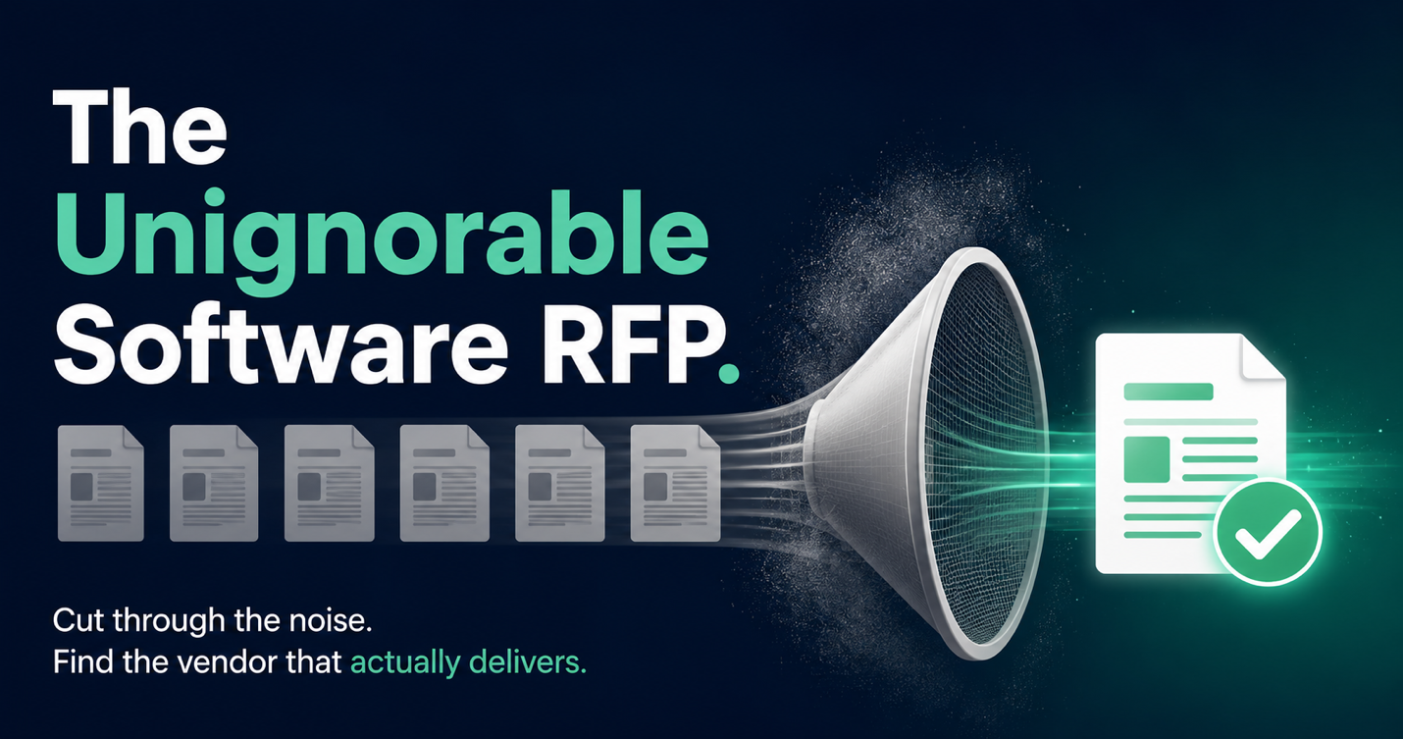
A strong software RFP works by forcing specificity from your team and vendors. Instead of using generic feature checklists, a good RFP uses business-outcome framing, scenario-based technical questions, and a weighted evaluation matrix. This way, proposals can be compared on actual substance instead of surface-level pitch.
This guide will answer how to write a software RFP that gets comparable, provable answers. We will include what you should ask vendors to cut through AI-generated boilerplate, and how to weight your evaluation criteria, along with a downloadable RFP + scorecard template that you can use in your next procurement cycle.
› Quick Summary (TL;DR)
Enterprise software selection fails when vague requirements invite generic sales pitches, hiding integration limits and hidden fees until you are already months into an expensive deployment. Fixing these procurement friction points isn’t bureaucratic busywork. Forcing technical specificity, writing scenario-based requirements, and enforcing an objective scoring matrix is a direct way to protect your engineering timeline and prevent deployment failure.
- The Framework: Align product, tech, and finance parameters internally to separate strict must-haves from optional line items before drafting
- The Shift: Replace your yes/no feature checklists with outcome-based user stories that force vendors to prove execution step-by-step
- The Velocity: Enforce a strict 8-week procurement timeline to lock down technical commitments before internal priorities shift or budgets change
› RFP vs RFI vs RFQ
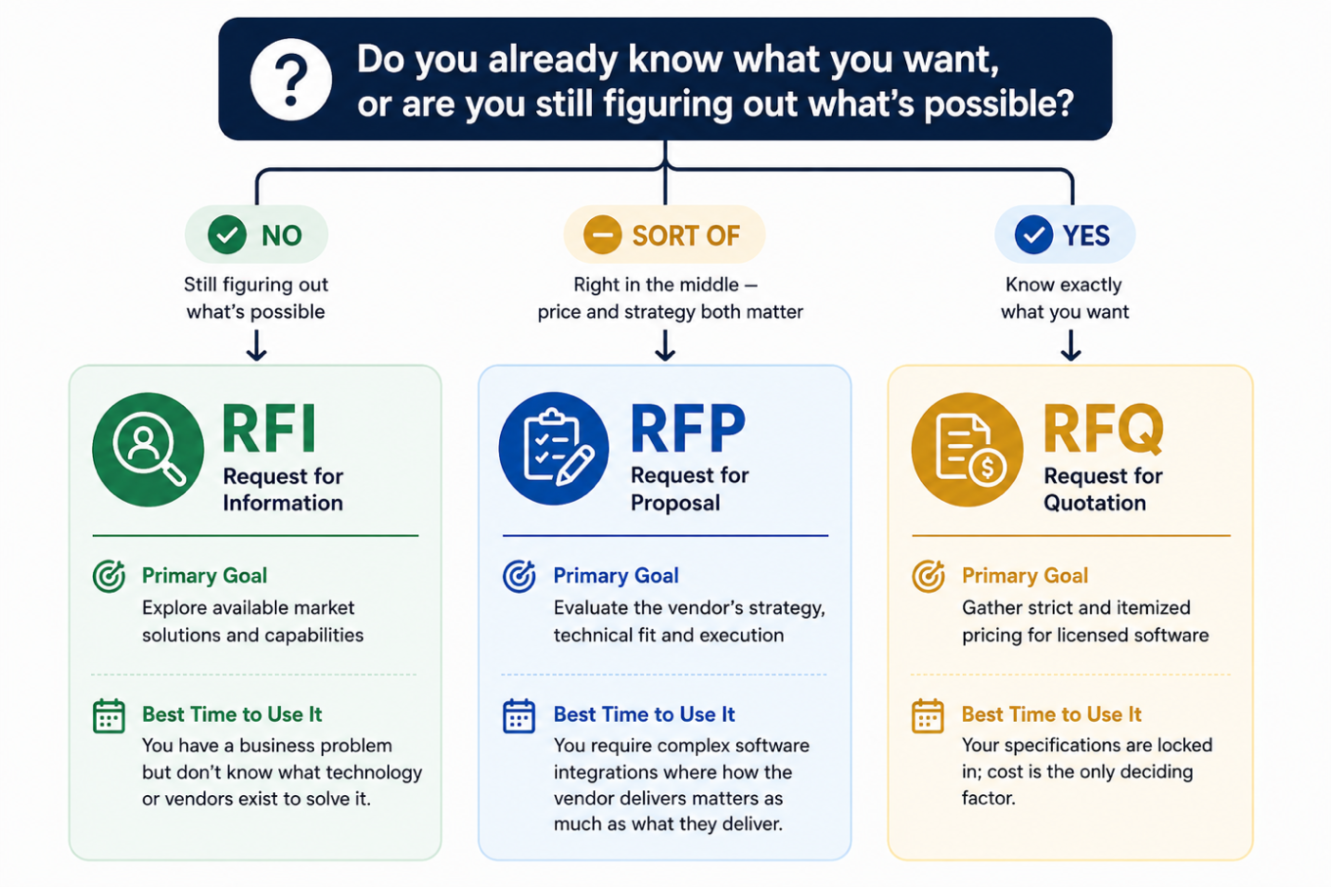
Before you write anything, you must choose the right document that fits your current buying stage. Using the wrong document wastes your team’s time and confuses vendors even before the process starts.
Enterprise procurement runs on three distinct documents: the RFI, the RFQ, and the RFP. Each one is built for a different moment in your buying journey.
Width: 1403px, Height: 935px
Width: 1403px, Height: 935px
Width: 1403px, Height: 935px
Width: 1403px, Height: 935px
Width: 1403px, Height: 935px
Width: 1403px, Height: 935px
Width: 1403px, Height: 935px
Width: 1403px, Height: 935px
Width: 1403px, Height: 935px
Width: 1402px, Height: 934px
Width: 1400px, Height: 933px
Width: 1396px, Height: 930px
Width: 1391px, Height: 927px
Width: 1387px, Height: 924px
Width: 1380px, Height: 920px
Width: 1379px, Height: 919px
Width: 1372px, Height: 914px
Width: 1371px, Height: 914px
Width: 1366px, Height: 910px
Width: 1364px, Height: 909px
Width: 1363px, Height: 908px
Width: 1362px, Height: 908px
Width: 1358px, Height: 905px
Width: 1356px, Height: 904px
Width: 1354px, Height: 902px
Width: 1351px, Height: 900px
Width: 1347px, Height: 898px
Width: 1346px, Height: 897px
Width: 1340px, Height: 893px
Width: 1339px, Height: 892px
Width: 1338px, Height: 892px
Width: 1336px, Height: 890px
Width: 1334px, Height: 889px
Width: 1332px, Height: 888px
Width: 1332px, Height: 888px
Width: 1332px, Height: 888px
Width: 1332px, Height: 888px
Width: 1331px, Height: 702px
Width: 1331px, Height: 887px
Width: 1331px, Height: 887px
Width: 1331px, Height: 887px
Width: 1331px, Height: 887px
Width: 1331px, Height: 887px
» Request for Information (RFI)
Use this to get started if you know your business problem but don’t know the options available to solve it. It is a fact-finding tool. It helps with market research, understanding what vendors actually offer, and narrowing them down to a qualified shortlist.
» Request for Quotation (RFQ)
This document is used when your technical requirements are already locked and non-negotiable. RFQ doesn’t include strategy and methodology questions. It focuses on cost. Use it for standardised and commoditised software licenses where price becomes the deciding factor.
» Request for Proposal (RFP)
If you need complex software integrations with vendor-backed customisation, migration support and ongoing SLAs, you should choose RFP. It evaluates technical architecture, functional fit, implementation strategy and even financial stability. That’s why it takes more effort to write than the other two documents.
| Document Type | Primary Goal | Best Time to Use It |
| RFI (Request for Information) | Explore available market solutions and capabilities | You have a business problem but don’t know what technology or vendors exist to solve it. |
| RFQ (Request for Quotation) | Gather strict and itemised pricing for licensed software | Your specifications are locked in; cost is the only deciding factor |
| RFP (Request for Proposal) | Evaluate the vendor’s strategy, technical fit and execution | You require complex software integrations where how the vendor delivers matters as much as what they deliver. |
If you are still not sure which one you need, ask yourself this question: do you know what you want or are you still figuring out what’s possible? The former indicates using an RFQ, while the latter points towards an RFI. An RFP is right in the middle of these two documents. It is meant for complex decisions where price and strategy both matter.
› Phase 1: Internal Discovery & Eliminating Scope Creep
You cannot ask your potential vendors for clarity if your own team isn’t aligned. You will get a vague RFP in this case, not because of your writer’s lack of skill. But because the business hasn’t agreed on what it needs before drafting the document.
Start by assembling what you call the Core Three: product, tech, and finance. The product team owns the features and workflow requirements; tech owns integration constraints, security and architecture fit, while finance owns the budget range along with the acceptable tradeoffs.
Once you have all three in one room, separate your requirements into must-haves and nice-to-haves. Be strict about your priorities.
If you add a nice-to-have feature in your RFP document as a requirement, it will eliminate vendors who would have been a strong fit otherwise. That’s because they don’t offer something you didn’t actually need.
Before finalising anything, you must flag your legacy data migration blockers. If you are moving off an existing platform, data structure mismatches and export limitations are where your timelines may go beyond the deadlines. It is better to know them at the RFP stage instead of discovering them six weeks into a signed contract.
If you are still narrowing down your vendor list, use comparison or category pages to build a more realistic shortlist of 3-5 vendors before drafting anything. It is faster than a cold search and helps you create an RFP aimed at platforms that clear your baseline requirements.
› Phase 2: How to Write a Software RFP
A software RFP is only as strong as its requirements section. Most templates you see default to feature checklists. That’s why vendors respond with generic and AI-generated pitches. Here’s a structure that’s built to close that gap.
» Executive Summary & Business Context
Open your RFP with a business outcome, not a feature request. Instead of saying “we need a CRM platform,” mention the metric you are trying to move.
“We need to reduce customer churn by 14% within two quarters.”
This single shift in how you start changes how vendors respond. A vendor who answers to a business outcome question explains how their platform helps you get there. But a vendor answering “we need a CRM” will confirm they have one with the features.
You must include these points in this particular section:
- The core business problem you are facing and the metric it affects
- Current tools/processes being replaced (if there are any)
- Timeline expectations for implementation, not just for proposal submission
» Functional Requirements as User Stories
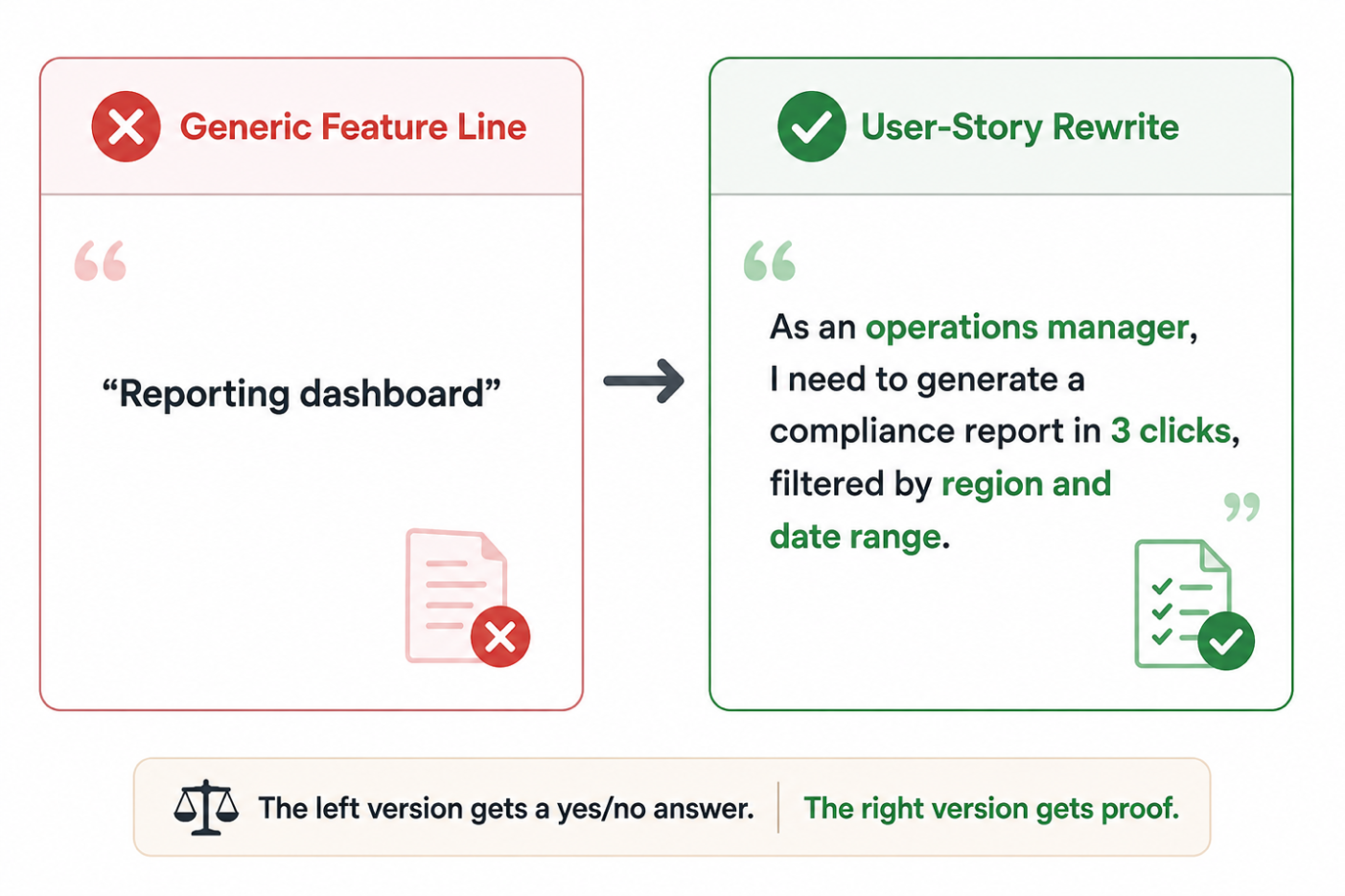
Feature lists invite a yes/no answer from the potential vendor. However, user stories force them to demonstrate the workflow, not just confirm they have the feature. Instead of saying you need a reporting dashboard, say this:
“As an operations manager, I need to generate a compliance report in 3 clicks, filtered by region and date range.”
Width: 0px, Height: 0px
Width: 1403px, Height: 935px
Width: 1403px, Height: 935px
Width: 1403px, Height: 935px
Width: 1403px, Height: 935px
Width: 1403px, Height: 935px
Width: 1331px, Height: 702px
Width: 1403px, Height: 935px
Width: 1403px, Height: 935px
Width: 1403px, Height: 935px
Width: 1403px, Height: 935px
Width: 1403px, Height: 935px
This format essentially does two things:
1. It tells the vendor what “done” looks like
2. You will not get an AI-generated response that pretends to be specific. A real platform would either support your workflow specification or it wouldn’t.
» Non-functional Requirements: The Pillars Most RFPs Skip
A generic RFP template stops at pricing and features. They skip the requirements that don’t show up until after the contract is signed. Usually, these aspects are discussed when an audit fails, the system can’t handle real usage, or performance lags.
Don’t add these requirements as an afterthought, buried inside an appendix. They need to be explicit line items that vendors can respond to directly.
| Requirement Area | What to Specify |
| Security and Compliance | SOC 2 Type II status, GDPR compliance, data residency requirements |
| SLA Guarantees | Uptime percentage, penalty clauses for downtime breaches |
| API Limits | Rate limits under peak load, webhook support |
| Scalability | What breaks first when the usage climbs to 2x or 3x |
» The Anti-AI Questionnaire Strategy
A standard yes/no questionnaire is the easiest for your potential vendor to deliver using a templated, AI-generated response. Scenario-based questions close that gap. Instead of asking “does your platform support single sign-on?”, ask them to walk you through how the new enterprise client with existing Okta infrastructure would be onboarded onto your platform. The answer should point to known friction points.
A vendor who has actually done that would answer with specifics, while the vendor relying on AI-backed boilerplate will answer with confidence and no detail. That is the trust signal you are looking for.
› 12 Vendor Questions That Filter Out AI-Generated Pitches
Most RFP templates ask a vendor to confirm what they offer. That’s exactly the kind of question an AI-generated response handles easily. It sounds confident but not accurate.
The questions below are built differently. They ask for specifics a vendor can only give if they have actually done the work. It also helps know what is happening on the other side of the table; understanding how vendors structure their B2B sales processes makes it easier to spot when proposals follow scripts instead of answering your question.
| Questions to Ask | What a Real Answer Sounds Like | Red Flag Answer |
| Walk us through a failed implementation and what you changed afterwards | Naming and explaining a specific failure mode with a concrete fix | “We always succeed” or when they give no example |
| What’s your actual API rate limit under peak load, not the spec sheet number | An actual number along with the conditions under which it is achieved. Real-production performance instead of marketing claims | Contact our engineering team for details |
| Show us a raw support ticket resolution log, not a curated testimonial | They are willing to share unfiltered data | Only a polished case study PDF is shared |
| What breaks first when we scale to 3x our current usage? | They name the bottleneck like database, API, storage, etc. | Our platform scales infinitely |
| Which of our required integrations have you never actually built before? | An honest gap disclosure | No gaps are admitted throughout the conversation |
| How long does a typical enterprise onboarding actually take, start to finish? | Mentions a specific range along with what causes that delay | A best-case number with no conditions attached |
| What’s the largest dataset you have migrated for a client our size? | Offers concrete numbers, such as data volume and record counts. | Vague reassurance without numbers backing their answer |
| Describe a time a client’s requirements changed mid-implementation. How did you handle it? | A specific process for scope changes | No real answer or something as vague as we are flexible |
| What happens to our data if we terminate the contract | Clarifies their export process with timelines | Extends ambiguity or says “ we will figure it out” |
| Who specifically will be our account manager and what’s their current client load? | They name the person with actual load | Promises a dedicated team but never names anyone |
| What’s one thing your platform doesn’t do well | A genuine limitation that helps you compare | Claims no weaknesses, which you discover otherwise later |
| Can we speak directly with a current client in our industry, no reference you have preselected | Willingness to arrange this even if imperfect | Reluctant to share the details. Only offers testimonials. |
The pattern is the same across all twelve questions. You ask for a number or a named failure, things a templated response can’t fake convincingly. If your potential vendor answers all these questions smoothly and specifically, it sends a strong signal saying they are the real fit.
› Phase 3: Building a Bulletproof Evaluation Scorecard
Even a well-written RFP falls apart at the finish line if your team scores proposals based on their instinct. A weighted evaluation scorecard removes that bias. It forces every vendor to be judged against the same criteria and similar proportions every time.
» Why Should Technical Fit Outweigh Cost?
It is tempting to let price drive your decision, especially when your finance team is sitting in the same room. But cost comparisons are easy to redo later; technical mismatches aren’t. A platform that appears cost-friendly but cannot integrate with your stack costs far more engineering hours than the sticker price could ever have saved.
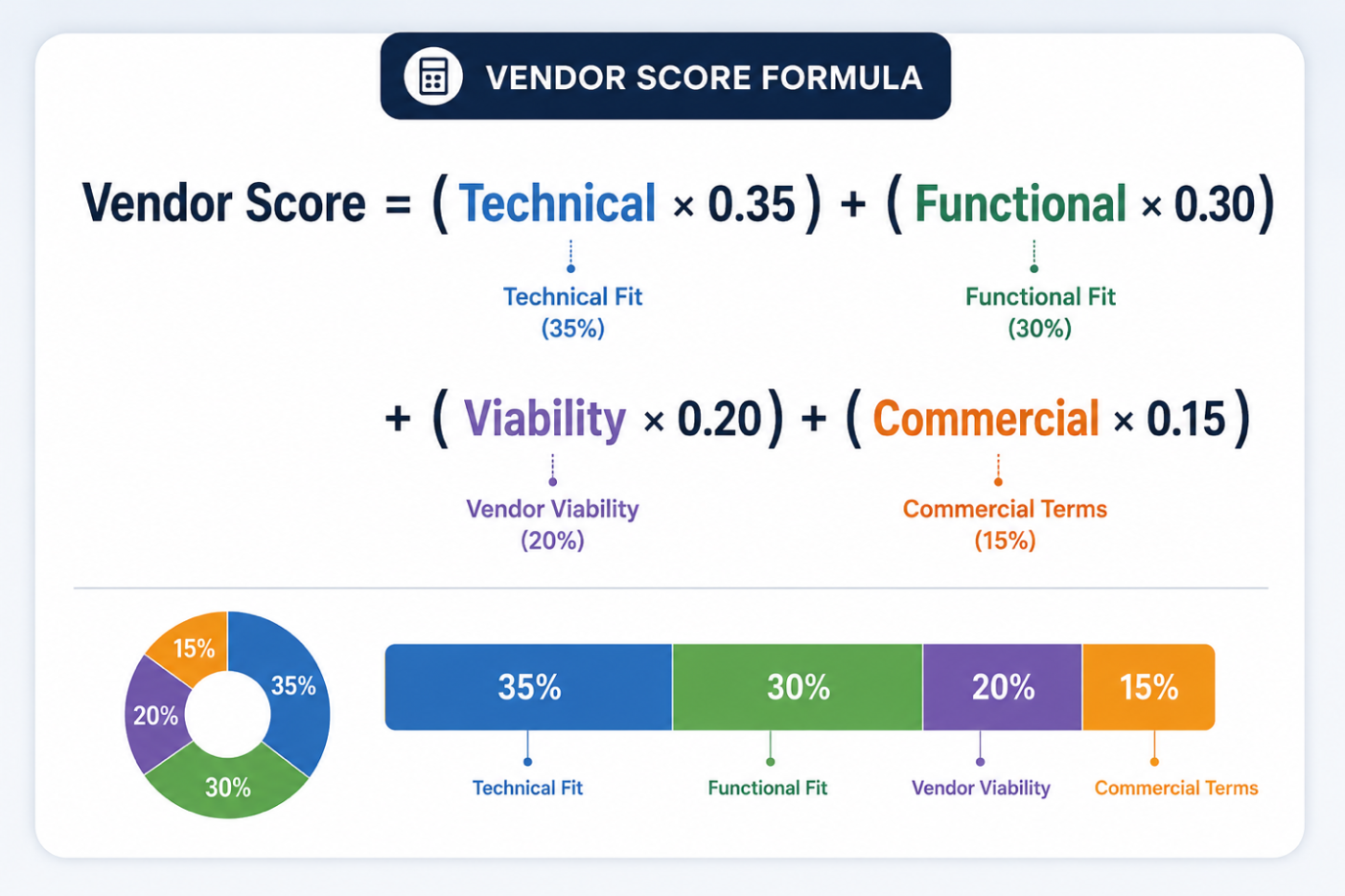
The Weighted Scoring Model
| Evaluation Category | Weight | What It Measures |
| Technical & Architecture Fit | 35% | API health, data latency, customising capability and security compliance |
| Functional Capabilities | 30% | Core feature performance against your actual user stories |
| Vendor Viability and Support | 20% | Account management, SLA response times and implementation training |
| Commercials and TCO | 15% | Hidden migration fees, API usage, licensing and setup costs |
Score each category on a scale of 1 to 5 for each vendor and then calculate.
Vendor Score = (Technical *0.35) + (Functional*0.30) + (Viability*0.2) + (Commercial * 0.15)
Width: 0px, Height: 0px
Width: 1403px, Height: 935px
Width: 1403px, Height: 935px
Width: 1331px, Height: 702px
Width: 1403px, Height: 935px
Width: 1403px, Height: 935px
Width: 1403px, Height: 935px
Width: 1403px, Height: 935px
Width: 1403px, Height: 935px
Score proposals after each demo and not days later once their impressions have blurred. Let each stakeholder score independently before discussing them as a group to ensure proper debate and discussion.
› Common RFP Mistakes
The most common RFP mistakes aren’t about missing information; they are about structure. Here is what you can go wrong about when creating an RFP, even when you are absolutely careful.
| Mistake | Why it Backfires | The Fix |
| Listing features instead of outcomes | Vendors answer this question literally, instead of responding to your need, as the latter isn’t mentioned | Frame your requirements as user stories tied to a particular business metric. |
| No response deadline enforced on the vendor | The process drags 2-3x longer than planned | Set a hard cutoff, with a defined Q&A window as an exception |
| Scoring vendors based on gut after each demo | Recency and personality bias can skew your decision-making | Score against your weighted matrix every single time |
| Skipping security and API depth | Issues surface after the contract is signed, especially when they are expensive to fix | Make SOC 2 status and API limits part of your scored line items |
| Treating the RFP as a one-way document | Vendors cannot ask clarifying questions, so their answers are generic | Build a structured Q&A round before the proposal is due. |
Specificity protects you, and vagueness lets a weak vendor inside your pitch and makes them your final choice.
› Phase 4: Managing the Timeline
Width: 0px, Height: 0px
Width: 1331px, Height: 702px
Width: 1403px, Height: 748px
Width: 1403px, Height: 748px
Width: 1403px, Height: 748px
Width: 1403px, Height: 748px
Width: 1403px, Height: 748px
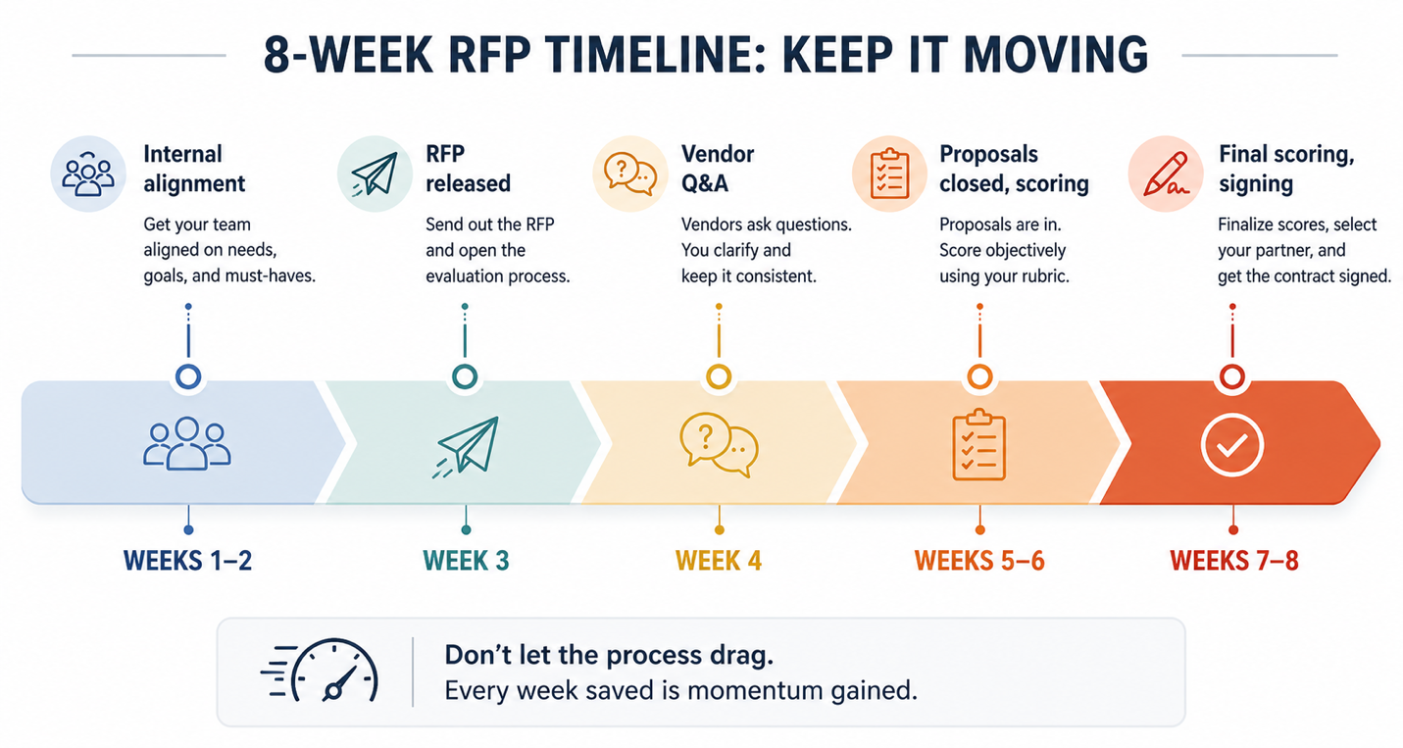
Even a strong RFP can slow you down if the timeline isn’t managed as carefully as the document itself. The longer a procurement cycle drags on, the more likely you are to lose the stakeholder’s focus, see budgets shift internally, or watch a vendor’s enthusiasm cool off.
Here is a realistic and high-velocity schedule for enterprise software procurement.
| Timeframe | Milestone |
| Weeks 1-2 | Internal alignment, stakeholder interviews, requirements locked |
| Week 3 | RFP released to a shortlist of 3-5 vendors |
| Week 4 | Dedicated Q&A for vendor clarifications |
| Weeks 5-6 | Proposals closed, scorecards evaluated, and sandbox demos |
| Weeks 7-8 | Final scoring, contract terms negotiated and signed |
Week 4 can be treated as a formality, but it is that week when you can catch vendors who go off-script. A well-prepared vendor uses this window to ask sharp, specific questions about your environment, while a generic one may not ask anything.
Keep this entire cycle under 8 weeks. Anything beyond that, you risk re-litigating requirements that were locked in week 2.
› FAQ
1. When learning how to write a software RFP, what sections should be included?
Ans. A strong software RFP includes business context tied to functional requirements written as user stories, non-functional requirements like SLA and security, and a clear metric. It also contains a weighted evaluation matrix and a defined response timeline.
2. How long should an RFP response period be?
Ans. It should be anywhere between 2-3 weeks, giving vendors real time to prepare a specific and thoughtful response. It should avoid being so long that the requirements or stakeholder priorities change.
3. How do you spot an AI-generated vendor response?
Ans. Look for generic phrasing that applies to almost all buyers, absence of specific numbers, no failure modes named, and an inability to go off-script when asked follow-up questions.
› Conclusion
A good RFP isn’t another bureaucratic paperwork; it is the document that determines how strong your vendor options are. The teams that get the best proposals aren’t the ones with a long requirement list. They are the ones who ask for specifics, score objectively, and give vendors no room to hide behind polished and generic pitches.
Everything in this guide, from business-outcome framing and scenario-based questions to weighted scorecard and managed timeline, exists to get you to one outcome: proposals you can compare based on substance and not presentation.
Don’t build this framework from scratch for your next procurement cycle. Apply this framework once, and it becomes a standard your team scores every future vendor against.