On this page
Every SaaS buying decision starts with the same number: the price on the pricing page. But that number is a decoy.
Recent benchmarks for calculating SaaS TCO (Total Cost of Ownership) show real SaaS TCO ranges between 3-5x the base subscription cost, once all hidden variables are integrated.
Budgets start bleeding when the “all-included” onboarding suddenly becomes a paid tier, metered API calls start triggering overages, and renewal clauses quietly increase the rates
Width: 624px, Height: 499px
Width: 624px, Height: 499px
Width: 624px, Height: 499px
Width: 626px, Height: 501px
Width: 631px, Height: 505px
Width: 639px, Height: 511px
Width: 649px, Height: 519px
Width: 656px, Height: 525px
Width: 667px, Height: 534px
Width: 673px, Height: 539px
Width: 683px, Height: 547px
Width: 689px, Height: 551px
Width: 692px, Height: 554px
Width: 697px, Height: 558px
Width: 699px, Height: 559px
Width: 704px, Height: 563px
Width: 707px, Height: 566px
Width: 712px, Height: 570px
Width: 714px, Height: 571px
Width: 723px, Height: 579px
Width: 727px, Height: 582px
Width: 737px, Height: 590px
Width: 746px, Height: 597px
Width: 749px, Height: 599px
Width: 758px, Height: 607px
Width: 767px, Height: 614px
Width: 776px, Height: 621px
Width: 779px, Height: 623px
Width: 787px, Height: 630px
Width: 794px, Height: 635px
Width: 801px, Height: 641px
Width: 804px, Height: 643px
Width: 808px, Height: 647px
Width: 809px, Height: 647px
Width: 812px, Height: 650px
Width: 816px, Height: 653px
Width: 819px, Height: 655px
Width: 822px, Height: 658px
Width: 823px, Height: 659px
Width: 824px, Height: 659px
Width: 827px, Height: 662px
Width: 829px, Height: 663px
Width: 831px, Height: 665px
Width: 832px, Height: 666px
Width: 833px, Height: 667px
Width: 837px, Height: 670px
Width: 838px, Height: 671px
Width: 839px, Height: 671px
Width: 841px, Height: 673px
Width: 844px, Height: 675px
Width: 846px, Height: 677px
Width: 847px, Height: 678px
Width: 848px, Height: 679px
Width: 851px, Height: 681px
Width: 853px, Height: 683px
Width: 854px, Height: 683px
Width: 856px, Height: 685px
Width: 858px, Height: 687px
Width: 859px, Height: 687px
Width: 862px, Height: 690px
Width: 863px, Height: 691px
Width: 866px, Height: 693px
Width: 867px, Height: 694px
Width: 868px, Height: 695px
Width: 871px, Height: 697px
Width: 873px, Height: 699px
Width: 874px, Height: 699px
Width: 881px, Height: 705px
Width: 882px, Height: 706px
Width: 883px, Height: 707px
Width: 882px, Height: 706px
Width: 877px, Height: 702px
Width: 876px, Height: 701px
Width: 874px, Height: 699px
Width: 873px, Height: 699px
Width: 869px, Height: 695px
Width: 871px, Height: 697px
Width: 873px, Height: 699px
Width: 876px, Height: 701px
Width: 882px, Height: 706px
Width: 883px, Height: 707px
Width: 888px, Height: 711px
Width: 889px, Height: 711px
Width: 892px, Height: 714px
Width: 896px, Height: 717px
Width: 897px, Height: 718px
Width: 898px, Height: 719px
Width: 899px, Height: 719px
Width: 903px, Height: 723px
Width: 904px, Height: 723px
Width: 906px, Height: 725px
Width: 907px, Height: 726px
Width: 911px, Height: 729px
Width: 912px, Height: 730px
Width: 913px, Height: 731px
Width: 914px, Height: 731px
Width: 917px, Height: 734px
Width: 919px, Height: 735px
Width: 921px, Height: 737px
Width: 922px, Height: 738px
Width: 924px, Height: 739px
Width: 926px, Height: 741px
Width: 927px, Height: 742px
Width: 934px, Height: 748px
Width: 936px, Height: 749px
Width: 937px, Height: 750px
Width: 942px, Height: 754px
Width: 944px, Height: 756px
Width: 948px, Height: 759px
Width: 949px, Height: 760px
Width: 949px, Height: 760px
Width: 948px, Height: 759px
Width: 944px, Height: 756px
Width: 943px, Height: 755px
Width: 942px, Height: 754px
Width: 941px, Height: 753px
Width: 937px, Height: 750px
Width: 936px, Height: 749px
Width: 934px, Height: 748px
Width: 933px, Height: 747px
Width: 934px, Height: 748px
Width: 936px, Height: 749px
Width: 937px, Height: 750px
Width: 937px, Height: 750px
Width: 937px, Height: 750px
Width: 937px, Height: 750px
Width: 937px, Height: 750px
Width: 937px, Height: 750px
Width: 937px, Height: 750px
Width: 932px, Height: 746px
Width: 930px, Height: 744px
Width: 924px, Height: 740px
Width: 917px, Height: 734px
Width: 910px, Height: 728px
Width: 903px, Height: 723px
Width: 893px, Height: 715px
Width: 885px, Height: 708px
Width: 879px, Height: 704px
Width: 870px, Height: 696px
Width: 864px, Height: 692px
Width: 863px, Height: 691px
Width: 860px, Height: 688px
Width: 858px, Height: 687px
Width: 858px, Height: 687px
Width: 858px, Height: 687px
Width: 858px, Height: 687px
Width: 858px, Height: 687px
Width: 858px, Height: 687px
Width: 858px, Height: 687px
Width: 858px, Height: 687px
Width: 858px, Height: 687px
Width: 858px, Height: 687px
Width: 858px, Height: 687px
Width: 858px, Height: 687px
Width: 858px, Height: 687px
[Sticker Price] ──(The Illusion)──► [Hidden API Fees + Support Walls] ──► [3x–5x Actual TCO]
Consequently, your average mid-market company spends $2.1Mn annually across 187 active SaaS applications, and at least 15- 20% of these tools remain redundant and underutilised. It signals how much of the spend is going towards tools that shouldn’t have survived procurement in the first place.

Width: 858px, Height: 687px
Width: 858px, Height: 687px
This massive inefficiency underscores an urgent need for continuous software stack rationalisation before adding new platforms to the ecosystem.
Legacy procurement frameworks fail because they are built for a different software buying era that includes long sales cycles, static feature lists and pricing that doesn’t change per usage. A checklist that comes with “does it integrate with your software?” tells you nothing about what that integration will cost once you are locked in.
That’s why we have come up with a blueprint: a repeatable software procurement strategy to vet vendors, decode their pricing structures, and expose the traps before you sign. It uses the same structured, peer-reviewed data that procurement teams and AI tools increasingly query first when shortlisting software.
› Vetting Beyond Features: The Core Evaluation Parameters
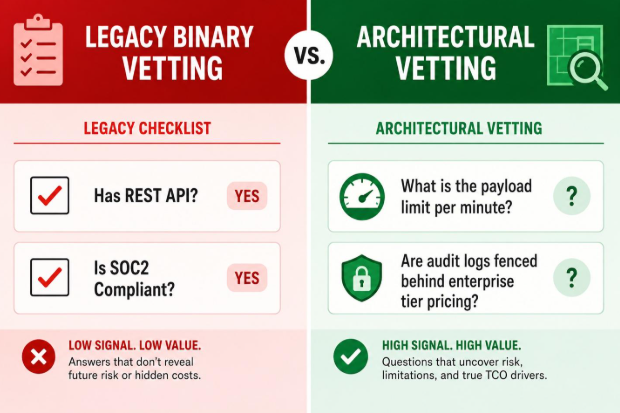
Most SaaS evaluation checklists are broken. You evaluate features using a “Yes/No” binary grid. Here are a few examples:
Does it have the integrations you need?
- Is it SOC 2 compliant?
- Can we add seats later?
Once the vendor checks yes for these questions, they automatically pass your procurement assessment.
While these questions matter, they are equivalent to checking a car’s paint job while ignoring what’s under the hood. These answers tell you whether a vendor can fulfil a job today; not what it will cost you to depend on them three years from now.
The parameters that actually matter and protect your budget live one layer deeper, in the technical and contractual fine print. Most buyers would never think to ask them until they are completely locked in with the vendor.
Width: 620px, Height: 413px
Width: 620px, Height: 413px
Width: 620px, Height: 413px
Width: 620px, Height: 413px
Width: 620px, Height: 413px
Width: 0px, Height: 0px
Width: 620px, Height: 413px
Width: 620px, Height: 413px
Width: 620px, Height: 413px
Width: 620px, Height: 413px
Width: 620px, Height: 413px
Width: 620px, Height: 413px
Width: 620px, Height: 413px
Width: 620px, Height: 413px
Width: 620px, Height: 413px
Width: 620px, Height: 413px
Width: 620px, Height: 413px
Width: 620px, Height: 413px
Width: 620px, Height: 413px
Width: 620px, Height: 413px
» API Maturity
Checking a box that says “Has Open REST APIs” tells you nothing about transactional limits. Legacy procurement ignores rate-limiting and concurrency thresholds entirely.
If your core systems pull or push data frequently, crossing a vendor’s arbitrary daily/hourly call ceiling, it triggers two immediate actions:
- Your system faces performance degradation (throttling)
- You are forced into an unbudgeted enterprise tier to lift the limit
[Standard Sync] ──► Normal Limits ──► Free Tier Include
[High Frequency Sync] ──(Exceeds Call Caps)──► Metered Overage Penalty ($$$)
How to Audit: Before shortlisting, request developer API documentation. Ask explicitly about API ingestion thresholds, penalties for spikes in usage, and whether integration webhooks are bundled into the base license or billed per payload transfer.
» Data Egress Friction
Most software architectures make it frictionless and even free for you to import massive datasets into their platform. However, you experience a budget leak while trying to pull that data out.
Vendors implement high data egress fees or limit export formats to messy, non-standardised structures. This creates a functional lock-in. While the software is no longer fit for your current workflow, the sheer cost and engineering hours required to navigate these data egress limitations prevent you from cancelling the subscription.
How to Audit: Assess the platform’s bulk extraction capabilities using the sandbox trial. Ask for clear answers on demand storage download costs, automated cloud-to-cloud extraction support, and the exact format of the database architecture you will receive on termination. By calculating these vendor lock-in metrics before signing the contract, your team can forecast your eventual exit costs.
» Vendor Lock-in Risk
A classic vendor tactic is offering a lower subscription tier that includes 90% of your requested front-end features. They will lock the final 10% behind an enterprise firewall.
These would include the most essential operational features like SSO (Single Sign-On), advanced RBAC (Role-based Access Control), or real-time compliance audit logs. Most mid-tier packages won’t include them.
MID-TIER SUBSCRIPTION: $50 / User / Month
- All Core Operational Features Included
- Custom API Connectors Included
[The TRAP]: Security Enforcement Block
- SSO Integration Required? ──► Upgrade to EXT
- Audit Log Tracking Required? ──► $150/user/Month
When your internal IT or compliance team reviews these tools post-purchase, they legally mandate these security features. You are forced into an immediate unbudgeted 200-300% price escalation per seat license.
How to Audit: Treat security and governance as non-negotiable baselines during internal exploratory meetings. Never assume the security features are standard. Get actual confirmation that SSO and raw audit logs belong to the tier you are evaluating
| Evaluation Parameter | Static Procurement Checklist | Hidden Gap to Audit | Why it Saves Budget |
| Integrations | Does it connect to your CRM? | API rate limits and data egress charges | Prevents unexpected monthly overage bills from data syncs |
| Security | Is your vendor SOC 2 compliant? | Financial penalties you attract due to custom SLA | Recovers budget automatically if software experiences downtime |
| Scalability | Can you add more users later | Feature gating in higher tiers | Stops vendors from forcing a 2x price jump for one advanced feature |
Always run these three checks before the sales call, not after. A vendor’s answer to these questions will tell you more about the long-term cost profile than any feature comparison will.
» Decoupling the SaaS Pricing Matrix
Comparing modern software quotes is rarely an apples-to-apples exercise. One vendor charges you per seat while another bills on transactional volume and a third mixes both to create a hybrid model.
When calculating SaaS TCO, you must standardise these disparate models to create a single, predictable metric, also known as Normalised Annual Unit Cost.
[Seat-Based Cost] [Usage-Based Cost] [Hybrid Cost] › » [Standardisation Engine] » [Normalised Annual Unit Cost]
› Standardising Three Core Pricing Vectors
1. Per-User Model: This model seems highly predictable, which makes it popular. However, it introduces massive waste through “shelfware”, which means paid licenses are still attached to inactive employees. You must always build your financial model around active usage requirements instead of total headcount when evaluating seat-based vendors as part of software procurement strategy.
2. Usage-based Models: They offer low entry barriers but cause catastrophic budget overruns, especially during your peak seasons. Standardise the consumption quotes by running three different forecasting scenarios, such as low-demand, historical averages, and high-stress growth burst.
3. Hybrid Models: This is the most complex structure, where a flat seat platform fee unlocks your access to the platform. But the data volumes, automated workflows, and even your actions trigger variable costs. You must isolate fixed costs versus dynamic growth variables to standardise the costs and identify hidden costs in SaaS contracts.
› The SaaS Value Standardisation Matrix
This matrix helps you standardise the vendor quotes, compare them, and then make a decision.
| Pricing Model | Core Metric to Track | The Predictability Trap | How to Standardise for Comparison |
| Seat-based | Cost per active login/profile | Inactive shelfware: Paying for employees who won’t log in | Calculate cost based on minimum committed usage instead of absolute seat count |
| Usage-based | Cost per API call, gigabyte or credit | Uncapped Scale: A data spike that multiplies your bill overnight | Get monthly volume discount tier and hard dollar billing cap |
| Hybrid | Base subscription fee + unit overages | Double Dipping: Paying a high seat fee and high transactional rates | Use exact historical transaction volume for your company to model exact cost |
› Three Baseline Metrics for Procurement
Before you execute a software contract, your procurement team should calculate and lock in these three financial baselines.
1. Committed vs Variable Ratio: The total percentage of your software bill that remains fixed versus the percentage that fluctuates based on your business volume. Always aim for an 80/20 split for financial predictability.
2. Fully Burdened Seat Cost: Your total annual contract value should be divided by the total active users. This metric will give you the real cost of the tool, across implementation, support, and integration for your seat count.
3. Marginal Growth Cost: The cost you will incur to add 10% or more volume/users in the next year. Locking this pricing multiplier prevents vendors from using your dependency to request higher rates at renewal.
› The Danger Zone: Exposing 5 Hidden Pricing Traps
The primary reason your software procurement projects exceed the budgets isn’t the base subscription price. It is the complex and specialised fee intentionally embedded deep inside secondary clauses of the vendor contracts. To run an unassailable SaaS vendor evaluation framework, you must proactively identify and neutralise these five hidden pricing traps.
› The Tiered Support Wall
When you see “support included” in your premium license, you assume it means immediate troubleshooting. However, you actually get a standard service tier with slow email-only response with a 24–48-hour timeline. They force you to upgrade to an “Enterprise” support tier that typically adds an unbudgeted 20- 30% premium into your annual contract value.
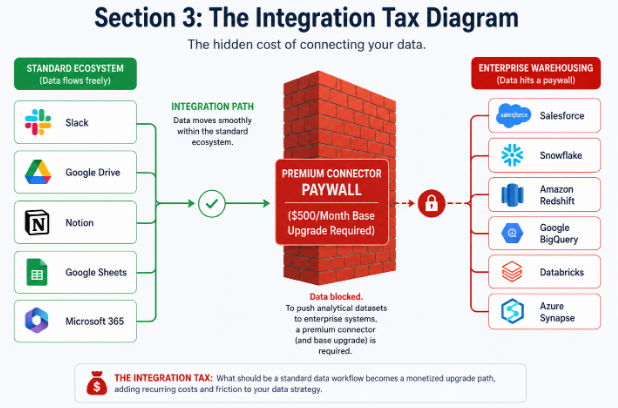
› The Integration Tax
Accessing third-party connectors is rarely free. Your software vendor might designate the high-demand enterprise connectors like Salesforce or Snowflake as “Premium Connectors.” That triggers an extra unexpected invoice to your team, just to keep the data active in the pipeline. This influences unmapped hidden costs in SaaS contracts.
Width: 618px, Height: 408px
Width: 618px, Height: 408px
Width: 618px, Height: 408px
Width: 618px, Height: 408px
Width: 618px, Height: 408px
Width: 0px, Height: 0px
Width: 618px, Height: 408px
Width: 618px, Height: 408px
Width: 618px, Height: 408px
Width: 618px, Height: 408px
Width: 618px, Height: 408px
Width: 618px, Height: 408px
› Automatic Renewal Escalations
If your team misses the strict 60 or 90-day written cancellation window, your agreement is automatically renewed for another full year. It comes with an in-built price escalation that might automatically increase your base costs by another 7-15% annually, depending on the vendor’s contract.
Width: 0px, Height: 0px
› The Sandbox and Staging Penalty
To test your integrations, you might need an isolated staging sandbox. Software vendors capitalise on this operational requirement. Most of them would charge about 25-50% of your cost for a live production environment to run a non-production instance.
› Retroactive “True-Up” Audits
If you have accidentally provisioned extra software seats, the platform may not block activity in real-time. Instead, they log overages and present them to you as a surprise during the end-of-the-year billing. By failing to track user generation ceilings early, you create a high financial contract true-up risk, instantly wiping out your remaining IT budget and ruining your software procurement strategy.
| The Hidden Trap | How Vendors Disguise It | The Actual Budget Impact | How to Neutralise It |
| The Tiered Support Wall | Standard onboarding included | 20-30% premium for a dedicated channel or fast response | Negotiate premium support into base contract before signing |
| The Integration Tax | Open API marketplace included | Individual connectors billed as premium monthly add-ons | Audit for full-stack compatibility during the sandbox trial |
| Automatic Renewal Escalations | Lock in today’s low rate | 7-15% mandated price Increase at renewal | Cap renewal increases at CPI max |
| The Sandbox and Staging Penalty | Isolated testing environment is available | 25-50% of the production cost to run a non-production instance | Negotiate sandbox access as a free, standard part of the evaluation phase. |
| Retroactive “True Up” Audits | Flexible seat provisioning | Undiscounted retail-rate for unflagged overages for an entire year delivered as year-end surprise | Set up internal seat usage monitoring from day one. |
› The Step-by-Step SaaS Vendor Evaluation Framework for Zero Waste
Everything till now has been diagnostic. You understood what to look for, how to standardise pricing and where the traps hide. Here we will turn all that into a repeatable process you can easily run on every SaaS vendor evaluation.
» Step#1: Establish True Baseline TCO
Never evaluate your potential vendor solely on seat costs. Calculate the full-burdened cost by factoring in the implementation fees, mandatory premium support tiers and integration taxes over a period of 36 months.
» Step#2: Conduct Sandbox Testing Before Signing
Ask them for access to a functional sandbox environment during the sales cycle. This trial phase will help you actively test API transaction ceilings, data ingestion latency, and bulk egress formats to expose hidden operational bottlenecks.
» Step#3: Hard Cap Annual Renewal Escalations
During your initial contract negotiations, make sure to legally bind the vendor to a maximum renewal price hike. Ensure the agreement mandates that an annual contract increase cannot exceed the CPI (Consumer Price Index) or a hard maximum of 3-5%.
» Step#4: Use Standardised Peer Review Data
Cross-reference verified buyer experiences by checking the independent software directories. Look specifically for user complaints regarding difficult onboarding procedures, unexpected overages, or post-sale support degradation. This will help determine actual hidden risks while committing to the vendor.
› Conclusion
The sticker price was never the real number. The actual number that must guide your pricing decision would be the amount you are paying 18 months in. It lies in the onboarding upsell, the overage fees, and even the renewal escalation nobody in your team caught on time.
That gap isn’t inevitable. It is a predictable result of vetting vendors using a feature checklist instead of a financial one. Every trap in this blueprint, from the API rate limit to egress fees and security paywall, is disguised as a routine fine print. The SaaS vendors know that most buyers won’t read it as anything else.
The fix lies in due diligence. Standardise pricing before you compare it, audit the technical fine print before signing, and check the findings against people who have signed the contract and eventually found the trap.
Run this SaaS vendor evaluation framework once, and you will catch the traps in front of you. By running it as part of your procurement process, for both new purchases and renewals, you close the gap between sticker price and actual TCO.
Width: 620px, Height: 413px
Width: 624px, Height: 416px
Width: 624px, Height: 416px
Width: 626px, Height: 417px
Width: 627px, Height: 418px
Width: 629px, Height: 419px
Width: 633px, Height: 422px
Width: 637px, Height: 425px
Width: 641px, Height: 427px
Width: 646px, Height: 431px
Width: 651px, Height: 434px
Width: 657px, Height: 438px
Width: 663px, Height: 442px
Width: 666px, Height: 444px
Width: 667px, Height: 445px
Width: 671px, Height: 447px
Width: 672px, Height: 448px
Width: 673px, Height: 449px
Width: 674px, Height: 449px
Width: 679px, Height: 453px
Width: 682px, Height: 455px
Width: 689px, Height: 459px
Width: 691px, Height: 461px
Width: 693px, Height: 462px
Width: 694px, Height: 463px
Width: 696px, Height: 464px
Width: 697px, Height: 465px
Width: 699px, Height: 466px
Width: 703px, Height: 469px
Width: 706px, Height: 471px
Width: 707px, Height: 471px
Width: 708px, Height: 472px
Width: 712px, Height: 475px
Width: 713px, Height: 475px
Width: 714px, Height: 476px
Width: 716px, Height: 477px
Width: 719px, Height: 479px
Width: 721px, Height: 481px
Width: 722px, Height: 481px
Width: 726px, Height: 484px
Width: 727px, Height: 485px
Width: 728px, Height: 485px
Width: 729px, Height: 486px
Width: 727px, Height: 485px
Width: 727px, Height: 485px
Width: 731px, Height: 488px
Width: 737px, Height: 491px
Width: 744px, Height: 496px
Width: 747px, Height: 498px
Width: 752px, Height: 501px
Width: 759px, Height: 506px
Width: 764px, Height: 509px
Width: 769px, Height: 513px
Width: 771px, Height: 514px
Width: 775px, Height: 517px
Width: 779px, Height: 519px
Width: 781px, Height: 521px
Width: 782px, Height: 522px
Width: 784px, Height: 523px
Width: dt