On this page
You are comparing quotes for an accounting or ERP system, and the vendor casually asks, “Would you like the cloud version, or should we install it on your own server?
So now, if you paused for a second after hearing that, you’re not alone. Most of the time, businesses evaluating software for the first time don’t really have a framework for answering that question. They simply go with whichever option the salesperson recommends more confidently.
What many people don’t realize is that this single decision influences almost everything that comes afterward, and it affects what you’ll pay over time. It makes us understand who’s responsible when something goes wrong, and how much control you’ll actually have over your own data.
› What These Two Actually Mean
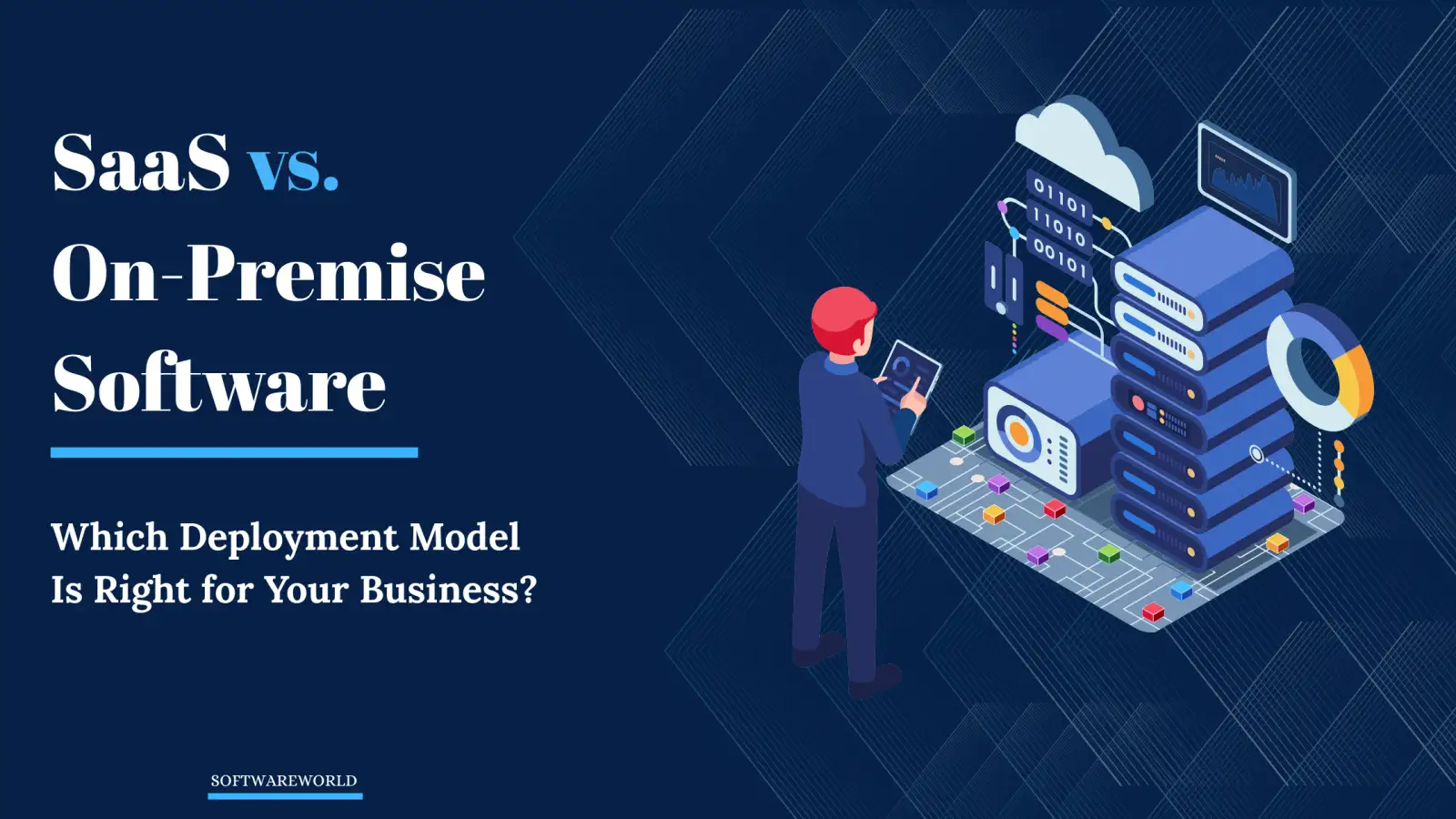
Now, once you strip away the sales language, the difference between the two is actually quite simple.
SaaS (Software as a Service) means you access the software through a web browser. The vendor owns the servers, takes care of updates, manages security, and handles maintenance. In return, you pay an ongoing subscription fee, usually monthly or annually, based on the number of users.
On-premise software works differently. The Software runs on hardware that you own, whether that’s a server in your office or one you’ve rented in a data center. You’re responsible for installing it, backing up your data, applying security patches, and fixing issues whenever they come up. That responsibility might fall on your internal IT team or an external service provider, but it is still your infrastructure to manage.
That’s really the core difference. Everything else- so if it’s cost, control, security, or flexibility- comes down to one thing only: Who owns and manages the infrastructure.
› The Cost Comparison Isn’t What It Looks Like on Paper
At the very first sight, On-premise software often seems like the cheaper option. You pay for the license once, maybe spend a few lakhs upfront, and that’s it. There’s no monthly subscription showing up year after year.
Wait, but the upfront price is only part of the story.
Working on your own servers comes with ongoing costs that rarely appear in the initial quote. Hardware eventually needs replacing, backups have to be managed, security patches need to be applied, and someone has to keep everything running smoothly. Even maintaining a server room adds to the cost through electricity and regular upkeep. And if the system goes down at two in the morning, someone’s phone is going to ring – and so that one person usually doesn’t come cheap.
SaaS works the other way around. The upfront investment is usually much lower, but the subscription continues for as long as you use the software. Now as your team grows and more users are added, the monthly cost grows with it.
Over three or four years, the total cost often ends up being surprisingly similar to an on-premises setup. Now the real question is not which one is cheap. It is whether you’d rather make one larger investment upfront or spread the cost over time with a recurring subscription that grows alongside your team.
› Control VS. Convenience
Here the decision starts becoming personal because it depends entirely on how your business operates.
With an on-premise setup, you’re in complete control. Your data stays on your own infrastructure, you can customize the software as much as you need, and you are not relying on someone else’s internet uptime. The trade-off, however, is that all of that control comes with the responsibility. So if your IT person leaves or something breaks, it is your responsibility to handle it practically.
SaaS takes a different approach by trading some of that control for convenience. Updates happen automatically, so you never have to worry about installing patches every month. The flip side is that you’re relying on the vendor’s servers, their uptime, and their security practices. Even if you wanted to, you wouldn’t have access to the underlying code.
Neither approach is universally better than the other one. The right choice depends entirely on what your business needs, which is something comparison articles tend to overlook.
› When On-Premise Still Makes Sense
It is very simple to think that on-premise software is outdated, but that would not be entirely true. Also, there are still situations where it’s the better choice.
Now think: if your business operates in a regulated industry with strict data storage requirements, on-premises may make more sense. So here’s an example of it: payment and Fintech companies in India often need to obey the RBI regulations that require certain types of payment data to remain on Indian servers. Therefore, depending on how SaaS vendors host and manage their infrastructure, meeting those requirements may not always be easy to understand. Now, if your business deals with this kind of data, it’s important to understand properly where your data will be hosted before signing any agreement.
Furthermore, in On-premise, it is also worth considering if you’ve already invested heavily in your own infrastructure and have an experienced IT team managing it. Moving everything to the cloud could mean walking away from an investment you’ve already made. The same applies if your business operates in an area where internet connectivity is genuinely unreliable. So now you know, in this situation, software that’s always expected to run through the cloud may not be the most practical option.
› When SaaS Is the Obvious Pick
For most small and mid-size businesses, this usually isn’t a difficult decision. If you don’t have a dedicated IT team, don’t want the responsibility of maintaining servers, and need to get up and running quickly, SaaS is often the more practical choice.
It scales as your business grows. Whether you’re adding new employees or reducing your team size, you don’t have to worry about purchasing or replacing hardware. It’s also a natural fit for remote and hybrid teams, since employees only need an internet connection and their login credentials to access the software, rather than connecting through a VPN to an office server.
› A Quick Way to Decide
Before making your decision, ask yourself a few simple questions.
- Do you have someone in-house who can manage servers, backups, and security patches, or would you need to hire someone for that?
- Does your industry have specific data storage or residency requirements that you need to consider before choosing a deployment model?
- Is your business comfortable with a recurring monthly subscription that grows as your team expands, or would you rather manage most of the cost upfront?
- On a typical bad day, how reliable is your internet connection?
If most of your answers sound like, “we don’t have that,” or “we’d rather not deal with it,” then SaaS is the better fit. On the other hand, if you already have the infrastructure, compliance requirements, or an in-house IT team, it’s worth taking a closer look at on-premises.
› A Quick Example
Let’s have a quick example here. So we came across a mid-sized manufacturing business that had been using an on-premises inventory system for nearly eight years. Not because it was still the best option, but simply because that’s what they’d always used.
Over time, their server started showing its age, their only IT contractor was close to retirement, and even small issues often took days to fix.
Finally, they moved their inventory and billing to a SaaS platform while keeping their financial reporting on a locally hosted system, as their auditor required certain records to remain on-site for compliance.
It wasn’t an all-or-nothing decision, nor did it need to be.
That’s often how businesses make the switch – choosing the model that works best for each part of the business instead of forcing everything into one approach.
› Where to Go From Here
Ultimately, if you’re still unsure which direction to take, the decision usually comes down to two things: how much in-house capacity you have to manage your own infrastructure and whether your industry has data regulations that influence your choice.
So start by getting clarity on those two areas. Once you do, the rest of the decision usually becomes much easier.
If you decide to adopt SaaS, learning effective SaaS user engagement strategies can help your team get the most value from the platform.
› Frequently Asked Questions (FAQs)
1. What's the real difference between SaaS and on-premise software?
Ans. Simple — SaaS runs in your browser, and the vendor manages everything. On-premise runs on your own servers, and you're responsible for keeping it alive.
2. Is SaaS actually cheaper than on-premise software?
Ans. Not always. SaaS costs less upfront, but subscriptions grow as your team does. Over three to four years, the total spend often ends up surprisingly similar.
3. Which businesses should still consider on-premise software?
Ans. Regulated industries with strict data storage rules — like fintech or payments — where you legally can't store data on a vendor's servers.
4. Can a business use both SaaS and on-premise at the same time?
Ans. Absolutely — and many do. You can run some functions in the cloud and keep others on-site, depending on what each part of your business actually needs.
5. How do I know which option is right for my business?
Ans. Ask yourself two things: do you have an IT team to manage servers, and does your industry have data compliance requirements? Those two answers usually decide for you.