On this page
What happens the next time your phone rings and nobody is free to answer? In most cases, the caller will hang up and move to your competitor. For a small business, a missed call rarely becomes a follow-up; it becomes a lost customer.
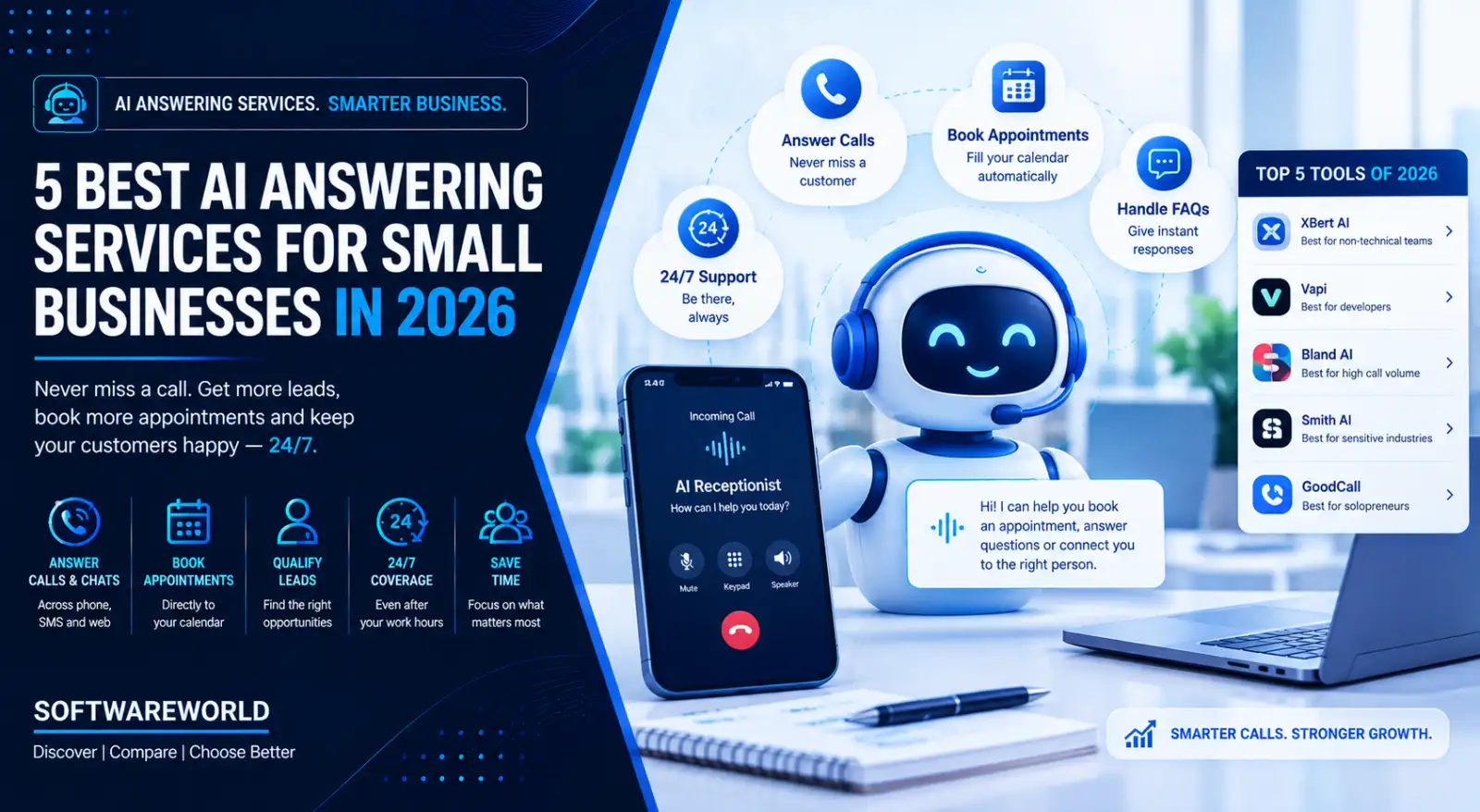
That’s why AI answering services are among the fastest-adopted tools for lean teams in 2026. Unlike old-school voicemail or rigid auto-attendants, modern AI phone answering services can hold real conversations with your customers. They can answer questions, book appointments, qualify leads, and even route urgent calls 24/7 without adding any headcount.
- You gain practical and measurable value by adopting these services.
- Fewer missed calls during peak hours or when your in-house team is busy
- After-hours calls are covered without adding people to the team
- Faster response times, reducing wait times
- Time back for lean teams as they manage routine calls and FAQs automatically
This guide covers a practical, 2026-focused overview of the five best AI answering services for small businesses. You will learn what each tool does well, where it falls short, and which one fits your team’s workflow.
› Quick Response Table
Here’s a snapshot of all five tools side-by-side to help you get insight into all of them.
| Software | Best For | Key Strength | Small Business Fit | Starting Price (2026) | USP |
| XBert AI | Non-technical teams | No-code setup, goes live in days | Excellent | $99 per month for 100 conversations. Starting price | 24/7 receptionist taking all your calls, SMS, and web chat. No engineering team needed. |
| Vapi | Developers and tech teams | Deep API integration and control. Low-latency voice | Moderate. Requires engineering time | ~$0.05 per minute platform fee. Additional pass-through costs are charged | You can build a fully custom voice agent from scratch |
| Bland AI | High call volume and complex workflows | Visual flow builder for call logic | Moderate. It is best when you are scaling | ~$0.09 to $0.14 per minute. $299-$499 per month | Can handle large and complex call volumes reliably |
| Smith AI | Law firms, clinics, and sensitive intakes | AI + human fallback | Excellent for high-stakes calls | ~$95 per month for AI-only tool. $292.5 for AI + human tool | A real person is the backup |
| GoodCall | Solopreneurs, tight budgets | Simple setup and flat pricing | Good for low volume of calls | Starts at $79 per month for the first 100 unique callers | Fast and no-code answering for basic conversations. |
› XBert AI
XBert AI is Nextiva’s AI receptionist and customer service assistant. It was built by Nextiva, a communications company founded in 2008 in Scottsdale Arizona. This AI answering service for small businesses runs on the same platform that already serves over 100k+ businesses and manages 2 Bn conversations in a year.
XBert AI answers your calls, texts, web chats and conversations on messaging apps like Telegram round-the-clock. It even completes tasks like booking an appointment, updating records and qualifying leads before hand-off to the executive with full context.
» Key Features
- Answers unlimited concurrent calls, texts and chats 24/7
- Trained on your business website, documents and Google Business Profile, enabling it to answer reflecting real policies
- Books, confirms and reschedules appointments directly into your connected calendar during calls
- Qualifies and captures leads, triggering your CRM workflows automatically
- Integrates with Google Calendar, Calendly, Zoho, and Housecall Pro at no extra cost. Integrations with Salesforce, HubSpot and Pipedrive available on request.
» Pros
- No-code setup. Goes live in minutes on an existing business number with assisted setup included at no cost
- One system for all your calls, texts, chat and messaging apps
- Strong calendar and CRM integrations
- Transparent and low-risk pricing with a 14-day free trial available
- Enterprise-grade platform underneath that is SOC Type II audited, ISO 270001 certified and HIPAA compliant
» Cons
- XBert AI is currently best-fit for US-based businesses only
- Built for non-technical operators. Not for developers who want to design their own custom voice platform from scratch.
» Best Fit Users
Businesses that are generally short-staffed and where inbound calls generate maximum revenue. For example, medical and dental offices booking an after-hours appointments or home service contractors that need to take calls while their crew in on job.
› Why is it useful for small businesses?
You get round-the-clock coverage for calls, texts and web chat without writing the code. It lets you go from sign-up to fully covered phones in the same week. For businesses where missed call becomes a missed booking, XBert AI turns “we will think about AI” into “our phones are covered 24/7.
› Vapi
Vapi is a developer-frist voice AI platform founded by Jordan Dearsley and Nikhil Gupta in 2020. Headquartered in San Francisco, it started out as a meeting-notes tool called Superpowered before pivoting to voice infrastructure.
This platform gives your developers a unified API, combining speech recognition with language-model processing and voice synthesis. It supports over 100 languages and is used by both early stage startups and large enterprises.
» Key Features
- Unified API that combines language model processing with text-to-speed and speech-to-text in a single pipeline
- API-level control over your call logic, voice models and prompts
- You can use your own LLM, STT, TTS and even telephone providers
- It supports over 100+ languages
- Real-time calling and automated testing for production voice agents
» Pros
- Maximum customization available. You can define how your AI should behave and integrate
- Low base platform fee ($0.05 per minute)making it a cost-eficient choice for teams managing the rest of the stack themselves
- Proven at scale, which makes it a great choice for enterprise-grade customers along with early-stage builds
» Cons
- The advertised $0.05 per minute is the orchestration fee. The real cost goes to $0.1 to $0.25 per minute when you add STT, LLM, and TTS.
- It requires a developer to continuously build, monitor, and maintain the agent.
» Best Fit Users
Tech-forward small businesses and startups with in-house or contracted engineering talent, wanting bespoke voice experience in their apps and workflows.
› Why is it useful for small businesses?
If you have engineering resources and require a fully customized solution, Vapi hands you complete control at developer level. It is the right tool for small and tech-led teams that treat phone experiences as a product extension instead of an off-the-shelf service.
› Bland AI
Bland AI is an enterprise voice AI platform founded in 2023 by Isaiah Granet and Sobhan Nejad. Headquartered in San Francisco, this platform was built immediately after the first healthcare platform ran into phone communication bottlenecks.
This tool can automate high volumes of inbound and outbound calls with sub-one-second latency. Its self-hosted infrastructure makes it suitable for industries like healthcare, finance, logistics and real estate that need tighter control over where call data lives.
» Key Features
- Visual, node-based flow building that maps out detailed branching paths and call logic
- Self-hosted infrastructure option for businesses in regulated industries
- All-in pricing for STT, TTS, and LLM for connected call time. It is billed by the second
- Voice cloning and mult-lingual support available on higher tiers
- Rates that reduce when your volume increases. For example, it is $0.14 for the free starter plan and goes down to $0.11 or $0.12 for paid tiers.
» Pros
- Built to handle serious concurrency and complex workflows reliably
- Transparent per-minute pricing, which includes core AI components. The rates drop from $0.14 per minute on the starter plan to $0.11 to $0.12 per minute on the $299 to $499 monthly tiers
- Self-hosting offers regulated businesses more control than competitors can give
» Cons
- It is built for technical users only. The setup might feel intense if you are only handling a modest number of calls
- The total cost rises when you add transfers, add-ons, and higher-tier plans
» Best Fit Users
Fast growing small businesses and agencies handling large call volumes or multi-step workflows. Teams that need call automation and data pipelines at scale.
› Why is it useful for small businesses?
It is perfect when you are expecting real scale, especially if you are on a steep growth curve. The tool offers workflow depth and concurrency that keeps call automation from becoming a bottleneck.
› Smith.AI
Combining AI call handling with live virtual receptionists, Smith.AI offers a hybrid AI answering service for businesses. It combines trust and human judgement for better conversations.
Most law firms, medical practices, accounting firms, and professional services use this tool. It is a good option for businesses with sensitive intake or where high-stakes calls should reach the person first.
» Key Features
- AI screens and routes calls before escalating them to humans as needed
- Two product lines. An AI-only receptionist and a hybrid virtual receptionist where AI manages both pickup and transcription. The North American agent will then handle actual conversation
- Intelligent conditional routing and warm transfers backed by your business logic
- Trained receptionists handle sensitive intake, payment collections, and even appointment bookings
- Bilingual support and CRM integrations are available with higher plans
» Pros
- Human fallback reduces the risk of your user getting stuck with AI on complex and emotional issues
- Gives small firms a polished 24/7 front desk with real people backing it
- A decade plus of call data behind the AI that guides the agents
» Cons
- It is the priciest option. The human-backed plans cost as much as $292.5 per month for just 30 calls
- The cheaper AI-only tier exists, but there is no human fallback, which is the core reason to choose Smith.AI
» Best Fit Users
Law firms, accounting firms, medical practices and other professional services with a sensitive intake. Basically any business where high-stakes call should reach a person first.
› Why is it useful for small businesses?
If trust and human judgement are equally important, this is a premium tool for you. In legal, medical and financial industries, high-stakes calls are regular and might need the safety of a real person backing the call.
› GoodCall
GoodCall is a no-code, fully streamlined AI phone answering service that prioritizes inbound call management, appointment scheduling and FAQs for small businesses. It is best suited for solopreneurs and micro-businesses with low to moderate call volume. Teams that need FAQs, basic booking and lead capturing covered can also choose it.
GoodCall started as CallJoy in 2017. It was a project inside Google’s Area 120 incubator built by former Google Speech AI leader Bob Summers. Its aim was to help small businesses like plumbers and HVAC contractors handle repetitive call questions.
Summers took it independently after Google shut it down and later named it GoodCall. It helps both solopreneurs and micro-businesses facing moderate call volume. You will also get basic FAQs and lead capturing with this tool.
» Key Features
- 24/7 inbound call answering using existing business information
- Rapid setup by connecting with your website or Google Business Profile. No engineering required
- Flexible logic flows with conditional yes/no, multiple-choice call handling
- Lead capturing and appointment booking involve simple rules
- Flat monthly pricing with unlimited minutes for each call
» Pros
- Simple and fast setup, built from ground up for non-technical small business owners
- Backed by genuine Google Speech AI expertise
- An affordable entry point. Monthly plans reported to range from $59 to $199 per agent depending on the tier
» Cons
- You are billed for a unique caller, not the minute. So a busy marketing month can trigger overage fees
- Integrations and advanced workflows are lighter in this tool
» Best Fit Users
Solopreneurs and micro-businesses with low-to-moderate call volume. Teams that need FAQs, basic booking and lead capture covered.
› Why is it useful for small businesses?
It is simple, affordable, and enough for basic needs. You might need to keep an eye on call volume, as the price increases with its growth. It is a wise choice for local retailers, solopreneurs, and small-scale providers, as you can set up AI answering services without any setup or engineering needs.
› A Buyer’s Guide: How to Choose the Right AI Answering Service for Your Small Business
There is no single best AI answering service for small businesses. Instead, you must consider the one that fits how you work. Run these questions through your validation before you commit to a service.
» How much setup effort can you take on?
If you don’t have developers on your payroll, use no-code tools like XBert AI or GoodCall. These two can go live in days. But if you have engineering support, platforms like Vapi and Bland AI extend flexibility. But you must also consider the cost of real setup and ongoing maintenance before proceeding.
» How does AI actually sound on call?
That is an important part. You don’t want AI sounding like a machine; you might ruin the conversational experience for your users. Take a demo or trial call. Check if it can handle a real conversation or falls apart whenever someone goes off-script. The conversational quality check is very important when choosing a platform.
» What do your calls actually need?
Be honest about why you are hiring the AI answering service. Basic FAQs and booking are completely different from screening sensitive legal and medical calls. For straightforward needs, you can go with a lighter tool. But you need something like SmithAI for high-stakes needs.
» Does it talk to your calendar and CRM?
A receptionist that doesn’t sync with your existing tools creates more work. Check for native and well-supported integrations with your calendar and CRM. Also check if the tool can update records and pass context to humans when needed.
» How are you actually billed?
The billing unit matters as much as the sticker price. Across tools, you will notice that they are billed per conversation, per minute, per call, or per unique caller. Run your average monthly call volume and call length against each model before signing up.
» What support do you get when something breaks?
Check for call transcripts, recordings, and even basic analytics. In case of regulated industries, you must confirm whether compliance features are available.
You can use these questions to shortlist two to three tools. Test each of the shortlisted tools against real call scenarios before making the final decision.
» Which One Should You Pick?
Each of these tools fits a different type of business need. Developer-led teams want full control, and that’s why Vapi or Bland AI is a good fit for them. High-touch practices, legal and medical, need human backup. SmithAI fits very well, while lean setups focused on low-cost basics appreciate GoodCall.
For small businesses looking for an easy, practical and non-technical AI answering service, XBertAI is a strong fit. It covers calls, texts, and even chat in a no-code system. You can go live in a few days, and it helps book appointments as well.
XBertAI is the most straightforward path for your business from missed calls to full coverage.