Table of Contents
Looking for effective ways to assess your team’s skills and knowledge?
You’ve landed at the right place.
There are multiple types of assessment options for you to choose from.
So
many options, in fact, that it would become tricky to select the best
one from the lot. The one that fits the goals and requirements of your
organization while complementing your internal processes.
At
the same time, the assessment option you choose should suit the way all
your teams work without hampering their existing workload or
operations. All while keeping the individual and collective evaluation
objectives in mind.
Sounds overwhelming? It is. No need to stress though.
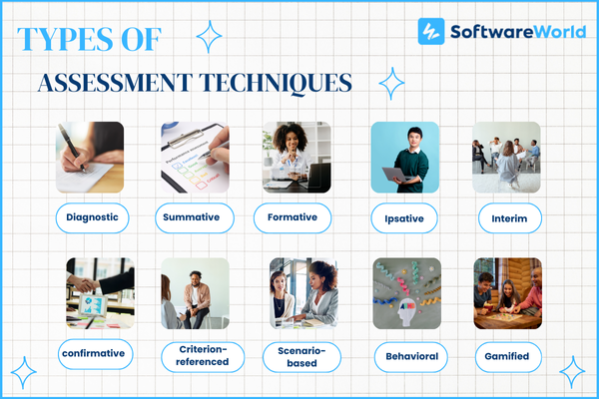
In this blog, we’ll walk you through the top 10 assessment types and the best scenarios to use them. Let’s begin!
»10 Types of Assessment Techniques
In this blog, we’ll walk you through the top 10 assessment types and the best scenarios to use them. Let’s begin!
»10 Types of Assessment Techniques
Width: 0px, Height: 0px
› 1) Diagnostic Assessment
One
of the most common types of assessment strategies, diagnostic
evaluation assesses the current level of knowledge/skills of the
learners (your employees). It also throws light on their learning needs,
enabling you to create tailored learning goals and programs for each
participant.
In simpler words, think of diagnostic
assessment as a test that reveals where the learners stand at present.
This assessment type is a vital part of the TNA or Training Needs
Analysis process that facilitates offering the right training at the
right time to the right people.
When to Opt for Diagnostic Assessment?
You
can carry out this assessment when your business requires structured
employee training to navigate the waters. Scenarios such as periodic
strategic changes, succession planning,
adopting a new business software system, forming a new department, and
revamping existing departments and teams are ideal for diagnostic
evaluations.
› 2) Summative Assessment
As
the name suggests, summative assessments are summary evaluations. This
type of assessment is conducted after the completion of a module, unit,
program, or the entire training. The results of this test help you
identify how much the learners have learned and progressed over time.
Even
better? Compare the outcomes of the summative test with the diagnostic
test results. It would clearly indicate the growth of your learners. At
the same time, it will check if your learning programs are effective
enough to benefit both the candidates and your long-term business
vision. You can also make necessary changes to the training, if needed,
post the results.
The best part? With this
evaluation type, it is simpler for learners, too, to recognize areas
where they excel and lack. And put in more effort accordingly.
When to Opt for Summative Assessment?
Summative assessments are carried out immediately after the end of a learning program.
Examples:
Unit tests, mid-term & year-end exams, assessment quizzes, and projects.
› 3) Formative Assessment
Think
of a formative assessment as an ongoing test that highlights your
employees’ skill adoption in real-time. Such assessments enable you to
identify the learners’ progress, proficiencies, knowledge gaps,
misconceptions, and struggles in a hassle-free way.
What’s
interesting is that formative evaluation can be conducted in both a
formal and informal manner. It allows the trainers to make the required
changes in their training methods to achieve a mutually desired learning
outcome. On the other hand, it keeps the employees actively engaged in
the learning process.
When to Opt for Formative Assessment?
You can conduct formative assessments during a learning session.
Examples:
Practice quizzes, group discussions, projects, and point exercises.
› 4) Ipsative Assessment
Ipsative
assessment stands out among the other types of assessments mainly due
to the level of personalization it offers. With ipsative tests, you can
compare the current performance of an individual learner with their
previous performance. That enables you to easily determine how much
progress or the lack of it the employee has made so far.
In
simple terms, ipsative evaluations can be called a test that
facilitates monitoring the learning progress of your employees at an
individual level. It vividly highlights the learners’ strengths, as well
as weaknesses, channeling the learning way forward.
Remember,
the goal with ipsative tests is to identify the distinct challenges
& struggles each learner may experience. And personalize the
training accordingly to meet their unique training goals.
When to Opt for Ipsative Assessment?
Such
types of assessments can be conducted anytime during the learning cycle
or whenever the instructor feels the need to check the learners’
progress.
Examples:
Assessments with scores and psychometric tests.
› 5) Interim Assessment
Interim
assessments are also known as benchmark evaluations. These are periodic
evaluations you can conduct to check the learning progress of your
employees.
The best part? Interim tests can be
conducted for a group of learners at the same time, unlike the ipsative
assessments that focus on an individual learner at a time.
An
interim assessment is an important part of the learning cycle due to
the clarity it provides on the training outcomes. It helps the
instructors understand if the training is on track with the desired
learning curve as well as results. Moreover, it indicates whether the
whole group is meeting the predefined standards of learning.
Once
you have the assessment results, it becomes easier to ascertain if the
training techniques need any modifications to suit the learners’
requirements.
When to Opt for Interim Assessment?
Such tests can be held once a month or a quarter.
Examples:
Final-term exams and monthly tests.
› 6) Confirmative Assessment
Confirmative
evaluations help in assessing the knowledge retention of the learners
in the long run. Such tests are typically conducted months after the
training program has ended. Think of confirmative assessments as an
extended version of summative evaluations.
With
this type of assessment, you can determine the viability of your
training programs, modules, and material. Simultaneously, this
evaluation puts to test the level of knowledge and skills the learners
have retained during the training period. It also helps ensure that they
continue to follow the standard practices and guidelines.
In
addition, the results of this test simplify the further course of
action, encouraging employees to keep reviewing and refreshing their
knowledge in their respective domains.
When to Opt for Confirmative Assessment?
Confirmative
evaluations are carried out after a stipulated time period, say several
months or even a year from the conclusion of the training program.
Examples:
Refresher tests, pop quizzes, spot checks, and topic discussions.
› 7) Criterion-Referenced Assessment
When
the evaluation finds its basis in predetermined standards or criteria
sets, it is referred to as a criterion-referenced assessment. Such
evaluations make it easier to measure and identify if the learners meet,
fail, or exceed the pre-defined learning criteria.
With
this type of assessment strategy, the employees know in advance the
expectations out of the training. Such tests act as a motivator for them
to master a particular skill to excel in their domain.
On
the other hand, a criterion-referenced assessment enables
instructors/trainers to provide the learners with personalized feedback
based on the evaluation data.
Please note that
such an evaluation offers direct insights into an individual learner’s
standings against the defined criteria, not their fellow learners’
performance.
When to Opt for Criterion-referenced Assessment?
Criterion-referenced
assessments can be conducted whenever there is a need to test the
employee’s knowledge/skills against the set standards.
Examples:
Annual
exams, checking the implementation of safety protocols, driving tests
to secure a license, and monitoring whether employees are fulfilling
their targets.
› 8) Scenario-based assessment
Scenario-based
assessments are also known as practical assessments and authentic
evaluations. It tests the learners on their ability to apply their
skills and knowledge in real-world scenarios. Such tests come under the
class of alternative evaluations.
With a
scenario-based assessment, it becomes smoother to assess employees on
several critical skills, such as decision-making, critical thinking, and
problem-solving. It helps them adapt to situations better, expand their
horizon for accepting different perspectives, and take on challenges.
Moreover, these tests promote innovation, pushing learners to think
beyond conventional ideas.
When to Opt for Scenario-based Assessment?
Scenario-based
evaluations can be done during the training program using assessment
software. It can even be carried out before beginning the training, as
well as after its conclusion. Such tests are also useful to screen
candidates during the recruitment process.
Examples:
Simulations, case studies, situational judgment tests, and role-playing.
› 9) Behavioral Assessment
Behavioral
assessment is a kind of psychological evaluation. The aim of this type
of assessment technique is to evaluate the behavior of existing and
potential employees.
Typically, such an
evaluation involves observing the learners in a simulated workplace
environment. They are given realistic scenarios related to their roles
in the organization. For instance, resolving a conflict or dealing with a
workplace issue. The employees are given a free hand to handle the
situation their way and based on their actions, the assessment results
are drawn.
This type of assessment helps
significantly in developing leadership qualities, designing strategies
for management and conflict resolution, and establishing and
strengthening team bonds.
When to Opt for Behavioral Assessment?
Behavioral
evaluations can be carried out whenever necessary. Many companies also
include it as a part of their recruiting process.
Examples:
Direct observation, structured interviews, and behavior ratings.
› 10) Gamified Assessment
Gamified
assessments are perceived as one of the most engaging types of
assessment strategies. As you may have guessed from the name, gamified
assessments use a game-type setup as their evaluation backdrop to test
employees on their skills, knowledge retention, and cognitive
abilities.
Think of it as an evaluation that comes across as a game for the ease of use it offers.
With
gamified tests, it becomes simpler to achieve active learning &
communication and offer faster feedback. Furthermore, the results of
these assessments can help provide a more personalized training
experience to each participant.
When to Opt for Gamified Assessment?
Gamified
assessments are widely used by organizations while hiring new
candidates. You can also use them during the training program to make
the entire learning process more fun.
Examples:
Augmented Reality (AR) assessments and interactive quizzes.
» Conclusion
Regular
employee assessments are critical for the growth of any organization.
They help you enhance your training programs while fostering a growth
mindset among your workforce. What we explored here are 10 types of
assessment strategies commonly used worldwide. Apart from these
techniques, you can go for skills assessment, norm-referenced
assessment, and personality assessment as well.
The best part? There are many powerful assessment software solutions out there to get you started without any hassles.