On this page
Twilio was intentionally chosen by your team as it was a safe and well-documented choice. And it worked for a while. But suddenly the invoices started increasing faster than your message volume, and the campaign you needed out on time is sitting in the A2P 10DLC review for weeks.
No matter how many times you reach out to support, your queries are unanswered, especially when it is crucial for business.
Now, you are weighing a switch, and that’s not a small call. One wrong move can cost you deliverability, launch dates, and unplanned migration spend.
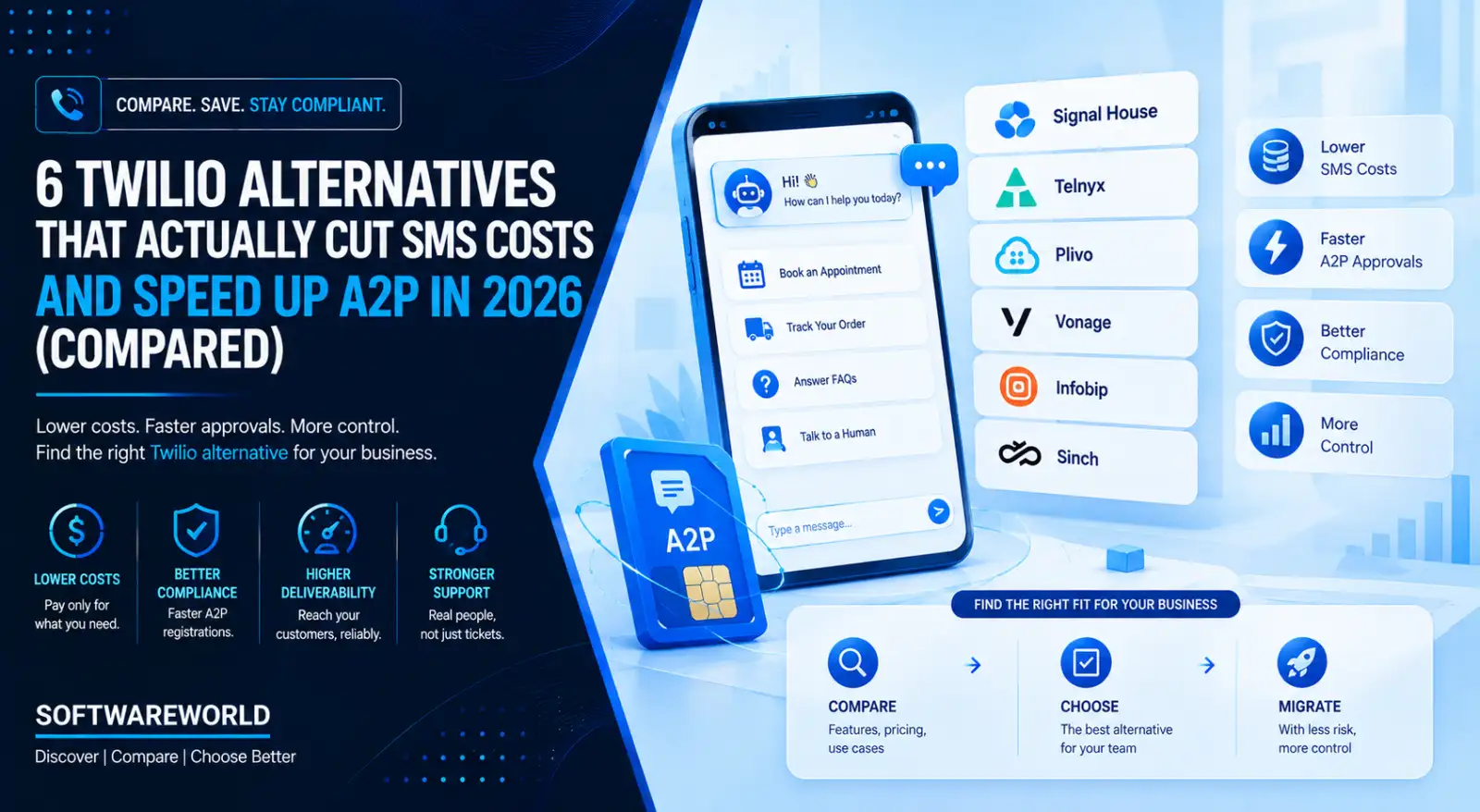
This guide compares six Twilio alternatives on cost, compliance, support, and migration effort needed. We have covered Signal House, Telnyx, Plivo, Vonage, Infobip, and Sinch. By the end, you can decide which one works for your business.
› Quick Verdict: Who Should Move Where and Who Should Stay
The right choice depends on who in your company will be doing the work. If the marketing or operations team is working with the tool, Signal House takes much of the work off your plate. It undercuts Twilio’s list rate and manages A2P registrations for you.
Telnyx has the lowest published US SMS rates, and its engineering team is core to setup and configuration. It expects you to manage routing and compliance.
Plivo makes the move easy if you are already deep in Twilio’s API. Vonage, Infobip, and Sinch fit enterprise omnichannel, global routing, and event-driven marketing needs, respectively.
| Signal House: Best Marketing and Ops Team | Telnyx: Suited for Engineering-led Teams |
Registration and troubleshooting fall on you with Twilio. Signal House flips that narrative. The team submits A2P 10DLC registration for your team and quotes about 48 hours for typical approvals. Pricing starts at $0.0065 per segment against Twilio’s $0.0083, and support is part of your account. This tool lets you build and send campaigns from the dashboards. Shopify merchants get a shared inbox while AI suggests instant replies. Note that it is a newer company, and calls go through the GoHighLevel dialer. So, check your voice needs before committing | Telnyx runs its own carrier network, as shown by the $0.0040 starting rate per segment, which is the lowest. There are no monthly minimums, and even AI agent costs $0.05 per minute. The flip side is that you need an engineering team’s complete involvement in configuring routing and handling compliance. There is no onboarding concierge or campaign dashboard. |
» Who Should Probably Stay on Twilio
A switch isn’t always the right move. Sometimes staying on Twilio may also be useful.
- When your product depends on Twilio Flex, deeply embedded verification & conversational APIs, or complex studio workflows
- If your team has built AI or automation logic on Twilio’s conversation and developer tooling.
In both these cases, the operational risk and migration cost outweigh the per-message savings you gain. In such cases, a partial migration may be safer than a full cutover. That means keep Twilio for core workflows and test an alternative for specific campaigns.
› Why Teams Start Looking for Twilio Alternatives
Most migrations from Twilio happen when pressures related to cost, compliance, and support compound. If you are feeling at least two of these at the moment, you are already ready for the switch.
» Costs that Outrun Volume
Twilio’s published US SMS rate is about $0.0083 per segment. Add carrier fees, regulatory surcharges, failed message charges, and number rentals, and you increase the total by about $0.003 to $0.005. In practice, a single segment often lands at about 1.1 to 1.3 cents before inbound costs. At 500,000 segments per month, the total cost goes to $5,500 to $6,500+. That is enough to turn your platform fee into a line item that needs to be fixed.
» Registration that Stalls Launches
A2P 10DLC requires brand and campaign approvals. A single rejection owing to mismatched business records or weak opt-in language can immediately reset the clock. That makes you lose 1-3 weeks to resubmission cycles, pushing campaign dates past their key milestone dates and breaking the product launch. Providers that handle registration and campaign changes reduce this risk significantly.
» Support That Arrives Too Late
A compliance pause, filtering issue, or even deliverability drop that hits costs every hour in ticket queues. If you don’t have a dedicated messaging engineer, generic support with slow responses can turn your problem into a business incident. Choosing alternatives that bundle hands-on onboarding with proactive compliance monitoring reduces downtime and the hidden cost of internal firefighting.
› At-a-Glance Comparison Table
| Platform | Ideal User Profiles | Setup and Onboarding | US SMS List Rate | A2P 10 DLC Handling | Automation Readiness | Best If |
| Signal House | Marketers, Agencies, SaaS Teams | Managed, no-code. Goes live in a single day | ~$0.0065 | Done for you in ~48 hours | No-code campaigns, custom AI integrations and third-party app integrations | You want quick approvals with marketer-friendly UX |
| Telnyx | Developer teams | Self-serve and engineer-led | ~$0.004 | Self-serve, standard 1-2 week approvals | Voice AI agents, custom AI integrations | Your engineers can own both configuration and compliance |
| Plivo | Developers moving off Twilio | Self-serve with Twilio-styled APIs | ~$0.0077 | Self-serve, gets ready in ~1 to 2 weeks | Agent Studio, LiveKit and PipeCat | You want Twilio-like APIs at lower unit costs |
| Vonage | Enterprises and contact centres | Sales-led, heavier configuration | ~$0.0081 | Full-support, enterprise tooling | AI Studio flows, Knowledge AI | Voice, video, verification and messaging in one suite is your priority |
| Infobip | Global brands | Sales-led contracts and complex onboarding | Quote given according to country and messaging volume | Managed centrally. Varies by country | Cross-channel conversational bots | You send international messages and need OTT fallbacks like WhatsApp, Viber or LINE |
| Sinch | Mid-market marketing teams | Platform setup with data integration | Subscription plus carrier fees | In-built consent tooling | Send-time optimization with content testing | You need app event triggered texts instead of raw API |
› Signal House
Twilio hands you the tools and expects you to assemble the process. But Signal House takes over the entire process. The team handles A2P 10DLC registrations and reviews standard campaigns, which impacts when launch dates are fixed.
It offers a no-code setup and runs underneath tools like GoHighLevel and Shopify with an API for custom solutions. Support comes with the account instead of waiting for you to upgrade. Additionally, the tool has full voice APIs and servers, making them the best alternative for Twilio.
Migration is typically light for teams using CRM integrations. For API-based setups, you might need to add standard dev work.
» Key Features
- Managed A2P 10DLC registration, including registry fees
- No-code setup and goes live in a single day
- Integrates with GoHighLevel and HubSpot plus an API
- Volume tiers drop to $0.0030 per segment above 10Mn messages/month
» Pros
- Hands-on registration and support included in the plan
- Clear rate tiers starting below Twilio’s
» Cons
- Savings headline and approval times are vendor-stated.
» Pricing
Starts from $0.0065 per segment with no minimum. It is at least 22% below Twilio’s list rate for entry volume
» Best for
Marketing teams, agencies, and SaaS platforms that need compliant messaging live.
› Telnyx
This tool is built for teams that want to control the setup. It runs its own carrier network, which keeps pay-as-you-go pricing low, with no monthly minimums or subscriptions.
You register through the portal and manage routing, configuration, and monitoring internally. There’s no campaign manager or onboarding concierge. Your savings come from the engineering team. With the voice AI agents, your teams can build conversational products.
» Key Features
- Pay-as-you-go SMS with auto discounts for high volume
- Own network with direct carrier connections
- Voice agents at $0.05 a minute. They get support from OpenAI or Anthropic key
- Portal-based 10DLC registration. Expect standard A2P timelines; no concierge to push approvals
» Pros
- Lowest starting price on US rate list
- Simple pricing and no monthly minimums
» Cons
- No campaign tools or onboarding help
- Each feature is metered separately. Model total costs before you commit to the tool
» Pricing
$0.004 per message part plus carrier fee. Phone numbers start at $1 per month; usage is billed separately
» Best For
Engineering-led teams that send out high volumes, where cost-per-message drives the choice.
› Plivo
The tool’s appeal lies in familiarity. Its API follows the same patterns Twilio developers know. That’s why moving core send-and-receive code isn’t a rebuild in this case. You just need to make a few edits.
Your savings with Plivo are modest, roughly 7%, depending on route and volume, below Twilio’s list rate. Plivo is a low-friction migration rather than a significant cost-cut for your business. Registration is self-serve, and it takes about one to two weeks. The campaign tooling leans towards developers.
» Key Features
- Twilio-style API for easier code migration
- SMS and voice on a single platform
- Agent Studio for visual AI agent flows
- LiveKit and Pipecat support voice AI pipelines
» Pros
- Lowest rewrite effort needed
- Pay-as-you-go with no minimum threshold
» Cons
- Small price gap between Plivo and Twilio
- Enterprise-pricing tiers that increase substantially at higher volumes
» Pricing
$0.0077 per outbound segment. Carrier surcharges are extra
» Best For
Development teams that have worked with Twilio code and are looking for modest savings without a rewrite.
› Vonage
Vonage is less a Twilio replacement and more a Twilio-scale alternative. With this tool, you get messaging, voice, video, and verification live in one enterprise suite. It extends 10DLC support and compliance tooling as well.
The list rate is at par with Twilio’s, so savings come from negotiated volume contracts rather than the rate card itself. Expect heavier configuration, premium support pricing, and a fully sales-led process for this tool. In return, your support team gets AI Studio to build flows and Knowledge AI to deliver a knowledge base for your platform.
» Key Features
- A single suite offers messaging, video, voice, and verification
- AI Studio flow builder for support teams
- Knowledge AI to enhance support-desk automation
- Enterprise compliance tooling
» Pros
- Broad coverage across all communication channels
- Mature enterprise-based compliance
» Cons
- Complex dashboards with heavy configurations
- Little to no price advantage at list rates
» Pricing
$0.0081 per outbound segment before volume discounts. Available with discounts on volume contracts
» Best For
Enterprises and contact centres that require several communication channels under a single contract.
› Infobip
This tool is specifically for products that outgrow US markets. Most Twilio alternatives are for domestic SMS. That’s where Infobip differs. It prioritises global routing, regional compliance, and reaching customers on channels they use.
It also supports Viber, WhatsApp, KakaoTalk and LINE with proper fallback logic in case a channel fails. They also have an experience platform that adds cross-channel conversational bots to boost marketing efforts. The cost is the main complexity of the tool. All contracts are custom and onboarding is enterprise-grade, which becomes overkill for a small US-only sender.
» Key Features
- Country and volume-based routing
- Regional messaging rules are managed centrally
- OTT channels with fallback routing
- Experience platform to create cross-channel bots
» Pros
- Strong international reach and support for multiple local messaging channels
- Centralised governance across regions
» Cons
- Complex contracting and onboarding
- Quote-only pricing that makes comparing different tools hard
» Pricing
Quoted according to the destination country and volume
» Best For
Global products and enterprises that are looking for reliable delivery.
› Sinch
Sinch combines marketing automation with enterprise-grade messaging to send event-backed texts. For instance, when there is a sign-up, abandoned cart or even a lapsed trial, an SMS would be sent without a custom API call for a trigger.
It is best for product-led SaaS and mid-market consumer apps, where SMS is just one channel in a larger user journey. You may not want to use this tool for transactional traffic like OTPs. Moreover, platform costs grow with your contact database.
» Key Features
- Messaging journeys that are triggered by in-app events like sign-up or abandoned cart
- Optimises send time for your messages
- Multi-variant content testing
- In-built consent tooling
» Pros
- Messaging and marketing automation happens from a single place
- Consent and governance are built into the tool
» Cons
- Costs increase as your contact list grows
- Better suited to marketing and journey-based messages rather than bare-bones transactional OTPs
» Pricing
Subscription-based pricing with volume-backed carrier fees
» Best For
Mid-market and product-led teams that run event-driven SMS marketing.
› Verify Before You Commit
A pricing page rarely tells you the full story. Do these two things to validate real cost and de-risk A2P before talking to any vendor.
» The Two-Invoice Test
Pull the last two to three invoices from your current provider and break each one down, line-by-line. Here are all the things you must check.
- Base message charges
- Carrier and regulatory fees
- Number rentals: local, toll-free and short/long codes
- Brand and campaign registration fees
- Failed or undelivered message charges
- Support or compliance add-ons
Add all these up and divide the final number by the total messages actually delivered. That gives you the true cost per message that no idealised number on a pricing page can.
Once you have this number, give it to two or three vendors. Share the exact same volume, route mix and message type to ask them for an all-in quote. This is the only fair way to compare providers because headline prices don’t always include everything you pay for.
» A2P 10DLC Rejection Checklist
Most of your campaign rejections come from a small set of avoidable issues. So, before you file, confirm these
- Your business name and EIN should match registry records exactly. There shouldn’t be any abbreviations or typos
- Privacy policy and opt-in form must clearly state you will send text messages and explain how recipients can stop them
- Sample messages are examples of what you will send, not placeholders with sample text
- Your website, opt-in form, and campaign description must define the same brand and use case.
Ask the vendor you are considering how they review submissions before filing and what they do when a campaign is rejected.
The provider who catches these issues before submission can save you from resubmission cycles.
› How to Choose and Move?
Once you have narrowed your shortlist, the next step is matching the team’s skills and constraints to the right platform. Then you must plan a migration that protects both deliverability and launch dates.
» Match Your Team to a Platform
Use this part as the first filter before diving into features or pricing.
- Signal House if your marketing team, agency, or SMB wants low effort and strong support that doesn't cost extra.
- Telnyx when you need a developer-led team to optimise costs at high volumes
- Plivo for those who aim to use existing Twilio codebase without the rewrite
- Vonage for enterprises needed video, voice, and messaging from the same place
- Infobip for products selling across borders and using local channels
- Sinch to trigger texts from app events for mid-market teams
» Compare Migration Efforts
How much developer time the switch costs depends on the platform you have chosen.
- Plivo: As the API follows the same patterns as Twilio’s, teams can move core send-and-receive code with limited rewrites in a matter of days. Anything built using Twilio-specific features still needs to be redesigned.
- Telnyx: You learn the platform’s configurations and routing setup from scratch. That’s why it takes longer upfront but gives you more control once built.
- Signal House, Vonage, Infobip and Sinch: These are built around flow builders or dashboards. You rebuild your logic using their tools. It is less coding and more configuration. It works for teams that don’t want to maintain custom integration code long-term.
› A Four-Phase Zero-Downtime Playbook
Treat migration as a controlled rollout for the best outcomes.
File in parallel: Start both brand and campaign registration with your new provider on day one. Make sure your current traffic is normal
Port Numbers in the Background: Start port requests early and keep existing numbers active till each port window says confirmed
Mirror and Stage: Rebuild send paths in staging environment and test delivery, latency, and opt-out handling before going live.
Cut Over in Stages: First move 10%, then 50%, and finally your entire traffic with clear rollback rules tied to delivery rate and error codes.
› Frequently Asked Questions
1. Is Plivo a drop-in replacement for Twilio?
Ans. Close enough but not an exact replacement. The API follows patterns Twilio developers know, so core send-and-receive code usually needs minor changes. But anything that’s built on Twilio features like Flex or Studio needs to be rebuilt separately.
2. How long does A2P 10DLC approval take?
Ans. It depends on the provider. Vendors with managed registration quotes take about 48 hours for standard campaigns. Self-serve filing takes about one to two weeks. Rejections restart the clock, so you must submit accurate business details to the provider you choose.
3. Which alternative is cheapest at 1 million messages a month?
Ans. On the published rates alone, Telnyx is the lowest. But volume discounts and carrier fees vary by provider. The only reliable answer comes when you request an all-in-one quote for your exact volume from all vendors.
4. Can I switch without downtime?
Ans. Yes. Run your old and new providers in parallel by registering and porting numbers in the background. Test everything in staging and move traffic in stages.
› Closing and Next Steps
The right Twilio alternative depends on the answers to these questions. Who will own messaging: operations/marketing or engineering? What you will pay once all the fees are calculated and how tightly the product is tied to Twilio-specific tools.
Use both a comparison table and persona map to narrow down to two or three platforms that fit your team. Now pull your last two invoices, run the two-invoice test and request all-in real quotes at your volume from the shortlisted vendors.
Calculate the true cost per delivered message, shortlist vendors matching your use case and run a pilot under controlled traffic on their tool. Do these things step-by-step, and you will get a data-backed migration plan you can defend internally.