On this page
It's easy to get excited about a new software development idea. But what is important to keep in mind is that only 10% of startups make it through their first year after launch. Among the most common reasons for their failure is the lack of product-market fit. Therefore, it is important to ensure that your raw idea is worthwhile before spending time, money, and energy on it.
When traveling you look through the available hotels, research potential sightseeing destinations, and clear your schedule, right? The same thing is true for product development. Take your time to test ideas before making commitments or investments in them. It will let you make better decisions and have fewer regrets.
One of the options on how to test your idea is to write a proof of concept (POC). A POC is a presentation that demonstrates the feasibility of an idea. Many startups go through POCs before they launch their product or service. But, is this necessary?
In this post, we'll explore some of the key considerations for startups debating whether or not to undertake a POC. By the end, you should have a better sense of what proof of concept is, how to write a POC, and its use cases.
» What Is a Proof of Concept?
A proof of concept is an important project discovery step that can help validate an idea and ensure that a product is feasible in real-world settings. Proving viability at the early stage of start development can reassure stakeholders and investors during the project execution and help team members identify unforeseen issues with product-market fit.
A proof of concept is often used in the development process because it allows for the reduction of project risk and gives decision-makers valuable insight into whether or not a certain idea will succeed. However, you won't need to use a POC for every single project that comes your way; some of them are based on already existing ideas that do not need to be proven.
» POC vs. Prototype vs. MVP

A minimum viable product (MVP), prototype, and POC all have one common goal: to verify the feasibility of a concept. However, each serves slightly different purposes, and understanding the differences between them is essential for any successful product development cycle.
You already know that a POC is an early step in the product development process that allows stakeholders to demonstrate and test a concept or idea. A proof of concept aims to show that if given enough time and resources, a project can be successful. Typically, POCs are conducted with minimal resources and typically only last for a few days or weeks. In this sense, it's more like an experiment than a full-fledged product. It typically answers questions such as “Can it be done?” or “How will it work?”.
A prototype demonstrates how to build your product and what it may look like once it’s complete. It usually involves iterative improvements to previous versions until they become polished enough for testing by potential users to measure usability and desirability. While the focus remains on testing concepts, prototypes provide the opportunity to get feedback from actual users before further developing the product into its final form. Prototypes often take far longer to design than typical POCs and can range from low-fidelity paper sketches to detailed interactive digital replicas.
Finally, an MVP is a version of a product that contains only basic features but is ready for market release. The goal of an MVP is not only to test user experience but also business viability by releasing it into real-world conditions to get quick feedback from customers regarding its demand and value proposition versus competitors to further refine it over time according to customer needs and wants.
An MVP should still be somewhat incomplete for companies to receive valuable feedback on what features should be prioritized before investing more resources into its development. This also allows teams to focus on delivering value rather than becoming overwhelmed with too many features at once while also giving customers something they’re willing to pay money for right away instead of waiting years until every feature they want is implemented.
In sum, a proof of concept is an experiment used primarily by internal stakeholders that helps validate assumptions quickly; Prototypes build upon these results by providing actual user feedback; finally, an MVP creates real-world conditions in which customers can determine market viability while giving companies insight into how best continue development according to their needs versus those of their customers.
» When Do You Use a Proof of Concept?
As we’ve already mentioned, a POC is mostly used when you come up with a brand-new and unique idea that was not presented on the market before.
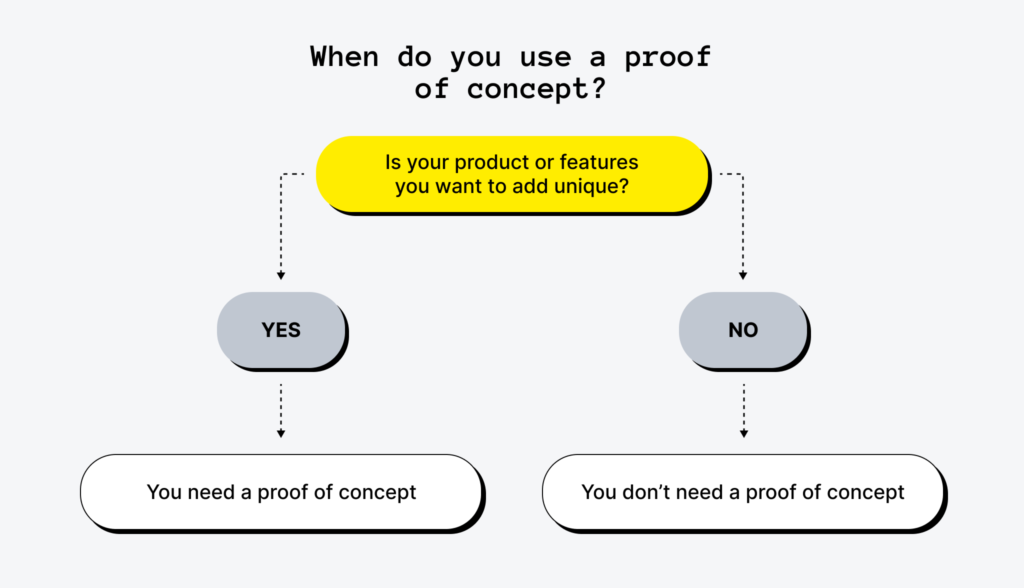
You may need a proof of concept in two cases:
-
- Starting a new project and developing a product that no one has done before. You will need to test your idea to make sure it is viable and will be used by people.
- Adding features to existing projects without previous use cases to compare. It is important to use an experimenter-friendly approach to make sure your changes won't negatively affect the core functionality.
In other cases, you do not need to perform POC actions because every envisioned functionality has already been tested and proven that it can be implemented.
» Benefits of a POC
Having a compelling proof of concept can have many benefits, especially for new and innovative products. A POC allows companies to quickly test out the feasibility and viability of a product idea before investing considerable resources into it. This allows them to have a better understanding of the project and evaluate its potential success rate. Among other advantages of a POC are the following:
-
- A POC allows stakeholders and developers to visualize their ideas before committing resources. It enables teams to test out different approaches and evaluate which one works best based on user feedback.
- A proof of concept provides an opportunity to identify any issues early on in the development process, allowing for quick tweaks if needed. This saves time and money down the line as well as improves efficiency during development.
- It gives visibility into how users interact with a product or service and allows developers to gain valuable insights into customer behavior which they can use when creating future products or services.
- A POC demonstrates progress and encourages stakeholder confidence in a project’s success since they can see tangible results from their investments.
With the benefits of applying a proof of concept, come to the risks when skipping it. If an idea is not well-defined or if there is not enough data to back your assumptions, you may end up with an expensive and time-consuming development project. Additionally, this may lead to the creation of a product that fails to meet user expectations. Do we have to mention that it can be difficult to recover from such a setback? The good news here is that writing a proof of concept is not rocket science and can easily be done in your startup.
» Essential Steps to Write a Proof of Concept
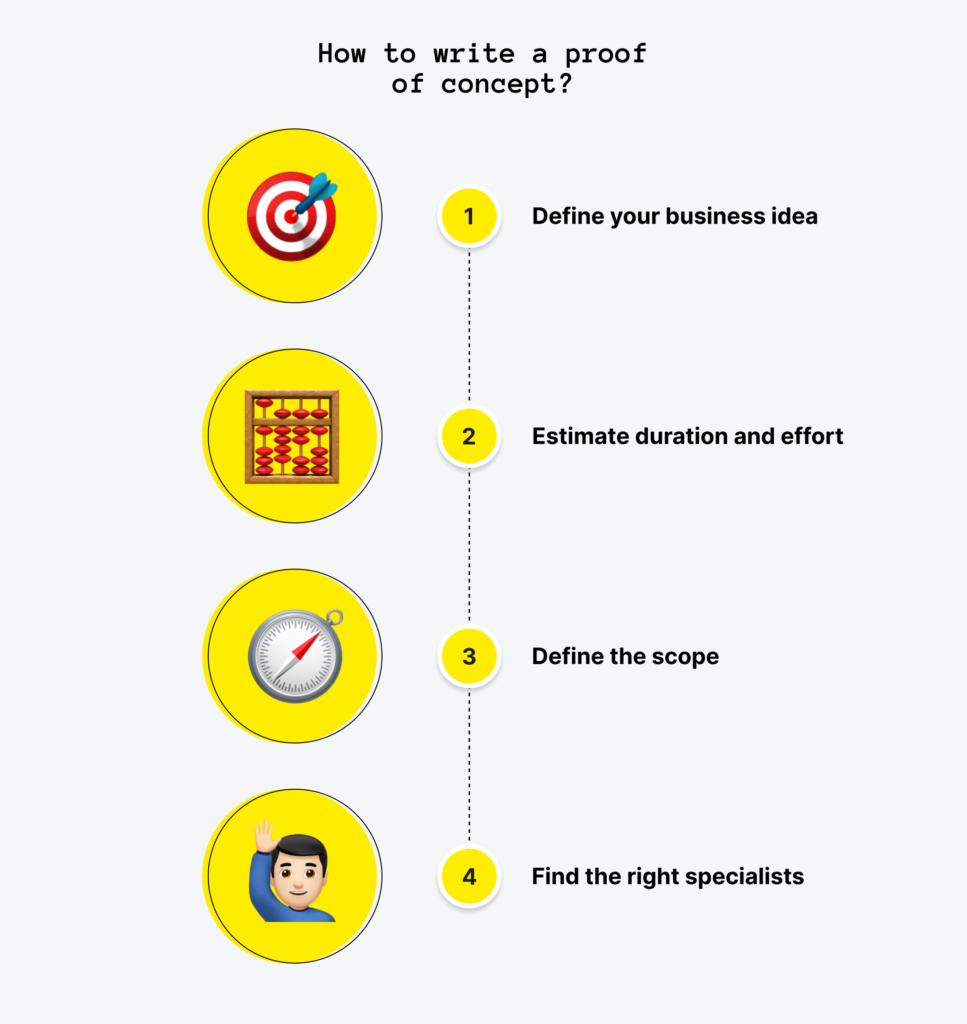
Let’s explore the common proof of concept steps that will give you an idea of where you should start with your POC.
-
-
Define Your Business Idea
-
The first step is to define the business idea behind the POC and set measurable performance goals. This involves exploring what the purpose of the project is, why it’s necessary, and what impact it could have on the business. Having clear objectives will help determine which resources are needed and inform decisions about budgeting and timeframes.
-
-
Estimate Duration & Effort
-
The second step is to estimate the duration and effort devoted to completing the task as accurately as possible. It's important to consider how much time and money is required for each stage of development as well as any additional resources such as personnel costs or software licenses that could be needed down the line. During this part of the process, it’s essential to review existing documents and discuss with stakeholders to gain an accurate understanding of what’s required from everyone involved in the project. This ensures that everything will run smoothly throughout the development.
-
-
Define the Scope
-
The third step is to define the scope of your POC so that everyone involved understands exactly what’s expected from them at every stage of development. At this stage, you should narrow down which features need to focus on during development, decide whether other activities will need additional resources such as user testing or quality assurance checks, create milestones that must be achieved before moving on to other tasks, etc.
-
-
Find the Right Specialists
-
Finally, hire a dedicated software development team that has all the necessary skills in developing POCs and later building an MVP so that they can ensure that all steps are taken correctly according to your plan. This may involve referring back to previous projects they have completed to make sure they have enough experience in tackling similar tasks with success, also ensuring good communication channels between them and other stakeholders involved to prevent any misunderstandings along the way.
By following these essential steps when writing a proof of concept, organizations should be able to make more informed decisions about their project investments while also increasing their chances for success at each stage along their journey toward completion.
» What Happens After a Proof of Concept in Software Development?
So you’ve created a proof of concept, what’s next?
-
- Test your POC. Does the proof of concept meet your success criteria? If yes, you can implement your ideas in real life and move to the next stage. If not, create another POC or fix existing bugs until the result satisfies you.
- Create a prototype. Decide how to visualize your proof of concept for a better user experience. UX/UI prototyping will help you combine unique features with standard ones and choose the best UI/UX design options.
- Create an MVP. An MVP gives the possibility to collect user feedback, fix any bugs, and improve your product so you can attract more customers. When you develop an MVP, you can scale and turn this version into a full-fledged product.
- Scale your product. It will help maximize the potential customer base without sacrificing stability or quality of service/product delivery. Additionally, it can help create competitive advantages over competitors who may not have been able to keep up with technological advancements or changes in customer demands over time.
» Summing Up
Before you invest too much time or money into an idea, make sure you create a proof of concept to test it out. By doing this, you can avoid costly mistakes and save yourself a lot of headaches down the road. Having a functioning proof of concept makes it easier for businesses to attract investors since they have evidence that their product has potential – this gives them access to more funding which helps move projects forward faster than ever before.
Similarly, potential customers are more likely to trust businesses that already have working prototypes because this implies reliability and quality assurance which greatly improves sales figures over time. Overall, having compelling proof of concept software development allows businesses to save time and money while ensuring that their products meet customer needs and bring value at every stage of their lifecycle; ultimately leading to increased profits long-term!